


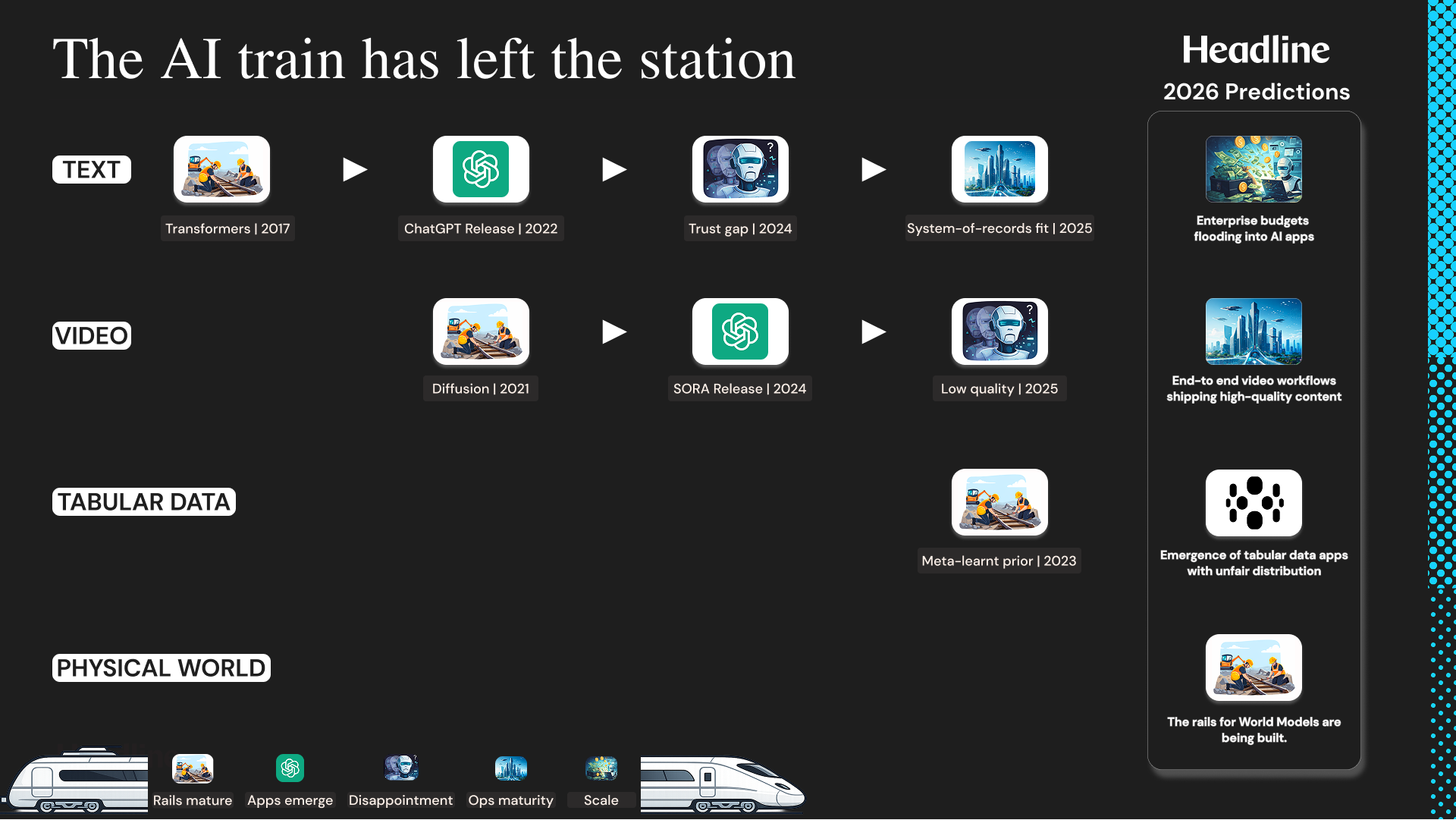
Rails mature, apps explode, reality hits, then adoption compounds.
My core view is simple:
When rails mature, applications emerge fast. In the short run, outcomes disappoint, but operational maturity then quietly compounds adoption.
Rails are the foundational models trained on specific asset types: text, video, voice, tabular data, and, more recently, the physical world.
Every AI wave follows the same adoption pattern:
Rails mature → Applications emerge → Magic demos → Deceptive outcomes → Operational maturity → Scale → Authoritative capabilities.
Where we are today:
Rails being built: tabular data, scientific research (bio, materials), the physical world
Magic effect: video and voice-based use cases
At scale: the most mature text-based applications like coding, customer support, scribes, and drafting
2026 is the year this cycle becomes visible across multiple rails, enabling agents to switch from assistive to authoritative capabilities.
Authoritative is when agents can autonomously execute end-to-end tasks inside real systems of record with permissions, logging, and measurable outcomes.
This fundamentally shifts the productivity paradigm: AI becomes a decisive actor, able to arbitrate between different paths, executing actions in the back-office, continuously running and optimizing parts of the organization 24/7.
1. Text rails are mature: Enterprise workflows are the battleground
In most enterprise deployments I see, text foundation models are no longer the bottleneck. They are strong, fast, and cheap enough for production. The hard part is everything around them: integrations, permissions, and what happens on edge cases.
That’s why competitive advantage has shifted from “better prompts” to a range of interdependent capabilities:
Deep integration with systems of record
Measurable ROI
Reliable handling of edge cases
Compliance and security readiness
End-to-end execution
High switching costs
Coding and customer support are the two enterprise use cases where most of these requirements are already being met, and usage, as well as spend, are scaling fast.
Why coding will remain the #1 killer use case
Coding has the cleanest feedback loops in enterprise software. You can measure time-to-ship, defect rates, cycle time, incidents, and review throughput. Early copilots delivered the magic effect: autocomplete felt like a superpower. Then reality hit: hallucinated APIs, inconsistent style, security concerns, and “looks right, breaks later.” The first verdict was clear: powerful, but not trustworthy.
Maturation is now obvious. In 2026, winning coding products will:
Understand full codebases, not isolated files
Run tests, diagnose, and fix failures
Enforce security, licensing, and dependency policies
Operate inside enterprise toolchains (CI/CD, secrets, observability)
Produce auditable changes and reviews that teams can trust
Coding shifts from suggesting code to shipping software safely and consistently.
Why customer support will be the #2 enterprise AI winner
Support is also highly measurable: resolution rate, time to resolution, escalation rate, CSAT, and cost per ticket. The magic effect was chatbot-based deflection.
Once again, the disappointment followed: failures on edge cases, stale or incomplete knowledge, poor escalation logic.
What maturation looks like in 2026 in my view:
Agents assist with grounded answers and citations
Agents that execute end-to-end actions (refunds, replacements, plan changes)
Quality monitoring and auditable outcomes
Strict guardrails for permissions, logging, and escalation
This does not happen instantly, though. Enterprise AI customer support is not plug-and-play.
It requires deep integrations (CRM, billing, identity, order management) and operational design (who approves what, when, and why), which is generally enabled by customization via services teams or forward-deployed engineers.
What’s exciting is that this is starting to work in production. We’re still in the early days, and it feels difficult to imagine any competitive enterprise company not adopting AI for CX/CS in a few years. This is the beginning of a budget expansion cycle driven by proven ROI.
2. 2026 is the year video rails mature: Video applications explode
Video is where text was a few years ago. The magic effect is already here: “I can generate a scene from a sentence.”
And the disappointment is here too: character inconsistency, broken brand coherence, and painful editing workflows. That is typically the stage right before rails mature.
Next steps for video rails in 2026:
Controllability: camera, style, structure
Consistency: characters, products, brand rules
Editability: local changes without regenerating everything
Provenance: rights, disclosure, traceability
Integration into creative workflows and distribution pipelines
Applications already emerged fast on the first video rails. But the winners will not be generic text-to-video tools. They will be end-to-end workflow products, such as performance marketing creative factories that ship variants at scale and learn what works.
The KPI becomes simple: speed to ship high-performing on-brand content and variants at scale.
3. New rails emerge on other data types: Tabular data is the sleeper
Text rails unlocked copilots first and autonomous agents now. Video rails unlock creation engines first and all-in-one content workflows now. The next big unlock comes when models become strong on other asset types: tabular data, scientific data, and eventually the physical world.
A near-term example I find compelling is AI for tabular data.
This applies foundation-model techniques to structured data in spreadsheets, databases, and warehouses to understand, predict, transform, and act on these tables. It matters because spreadsheets still run a huge part of enterprises, which gives tabular rails an unfair distribution.
If tabular data rails mature, here are the applications I expect:
Automated cleaning, joining, and reconciling data
Forecasting and scenario planning
Anomaly detection
Narrative reporting with traceability back to source tables
Agentic spreadsheet workflows safe enough for finance and operations teams
This will look boring from the outside, but will be massive on the inside.
4. Multimodality unlocks AI for the physical world
A longer-term rail will be the so-called World Models. Intelligence is still captive in the digital world in any data type mentioned above, and breaking it out into the physical world will create a whole new range of use cases.
They will rely on multi-modality and will be able to combine vision, language, audio, and action.
Even though we are at the research stage here, I think early adoption in 2026/2027 will appear in some constrained environments with a clear ROI, such as:
Logistics and warehouses
Manufacturing
Retail operations
Medical care
Domestic labor
My take is that voice, as the lowest-friction interface, will be crucial in unlocking real-time interaction, and video and 3D data will enable AI systems to go from perception to reasoning in the physical world.
The mental model for 2026
Rails mature → Applications emerge → Magic demos → Deceptive outcomes → Operational maturity → Scale → Authoritative capabilities.
The winners push through the disappointment phase. They solve edge cases, integrations, security and auditability, evaluation, and human-in-the-loop control.
2026 is not the year of better demos. It is the year rails become reliable enough to make applications unavoidable. Teams stop buying AI features and start buying systems that take responsibility for outcomes.
These are my 2026 bets, and I look forward to meeting the most ambitious founders tackling those!