



We revealed the 2026 AI Europe 100 on stage at RAISE Summit. The full presentation is here.
Every market map classifies AI companies by sector: infrastructure, enterprise, vertical, health, climate. The Headline AI Europe 100 classifies companies according to what they sell and what they replace. This test sorts an AI company in seconds and predicts business models, metrics, and moats, unlike other market maps.
The Europe 100’s six breeds are deliberately heterogeneous. Take a voice model, a sovereign LLM developer, and a biology foundation model: a sector map files them under media, enterprise, and health – three columns with seemingly nothing in common. This map puts them into one breed because they sell intelligence – the model itself – and are analyzed using a similar framework. What a company sells, what it replaces, how capital converts into moat, where margin compounds, and where it is capped: these shared patterns determine how the analysis should be done.
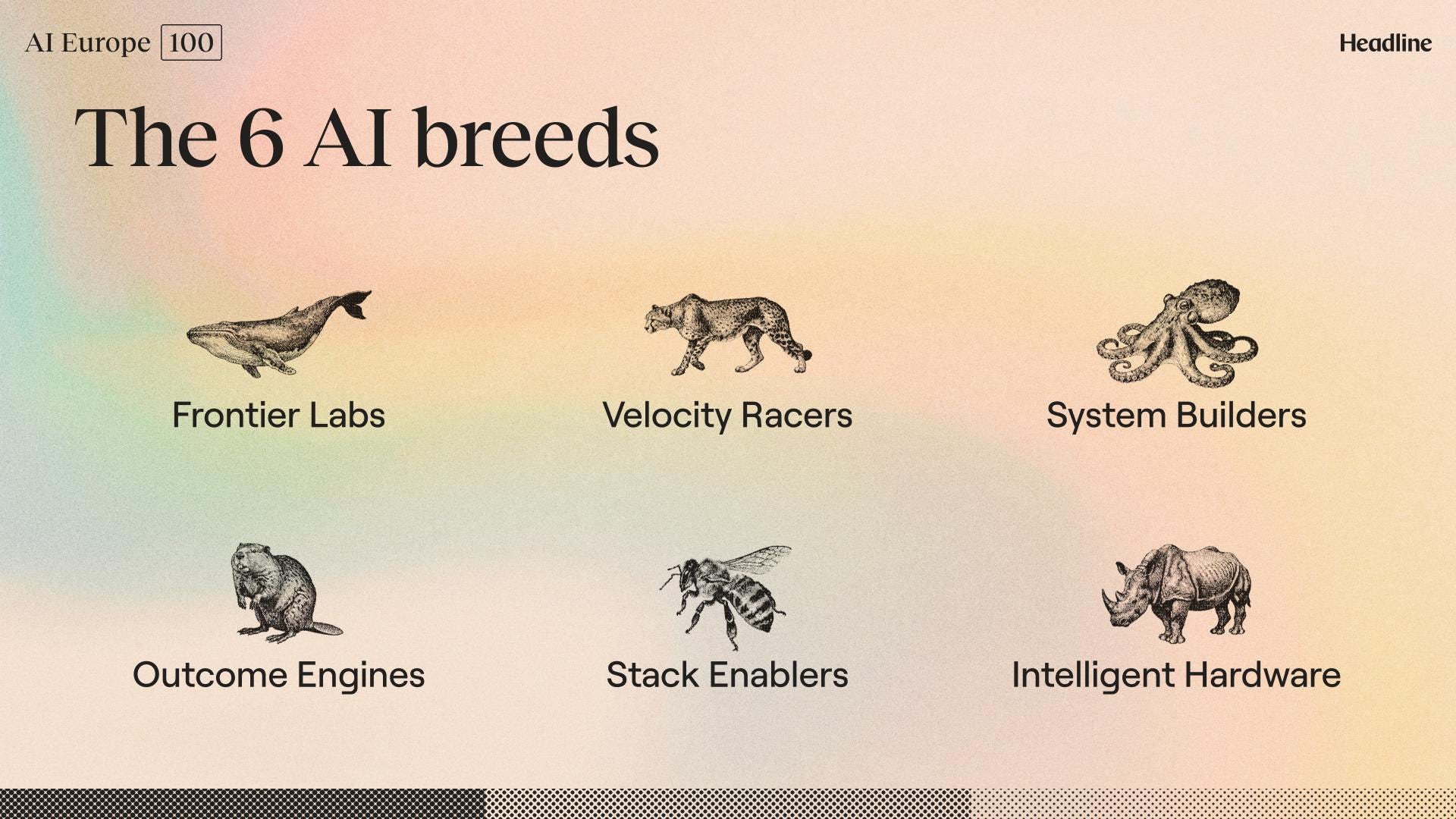
This year, we decided to release our framework: each category has a corresponding animal that exemplifies its unique qualities.
Reading note. The framework is global, and the lens is European, with European players marked [EU] throughout. Key figures were re-verified against public sources on July 3, 2026.
The six breeds at a glance
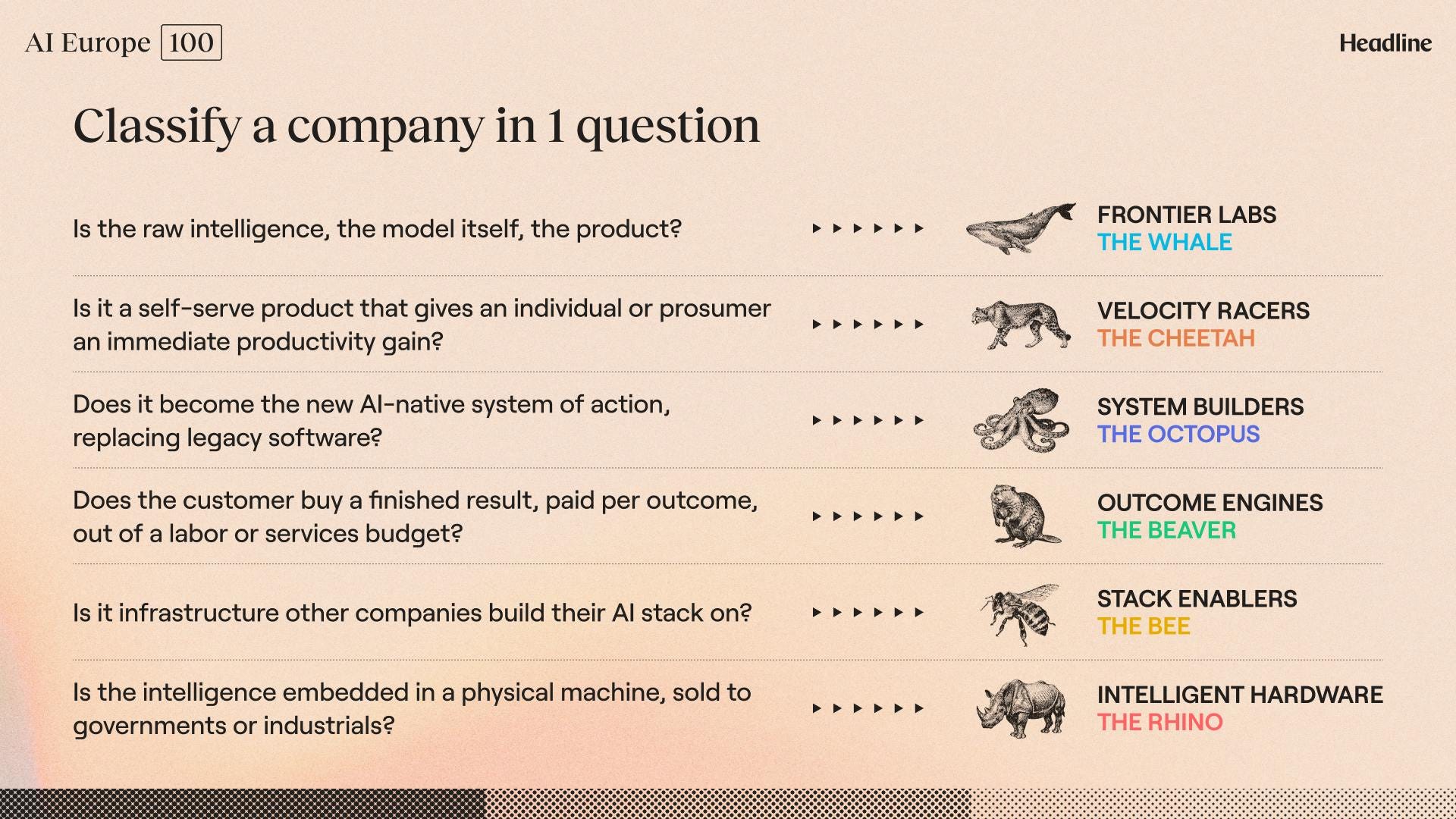
How to classify a company in 10 seconds
One question per breed. Ask them in order; stop at the first yes.
01 · Frontier Labs
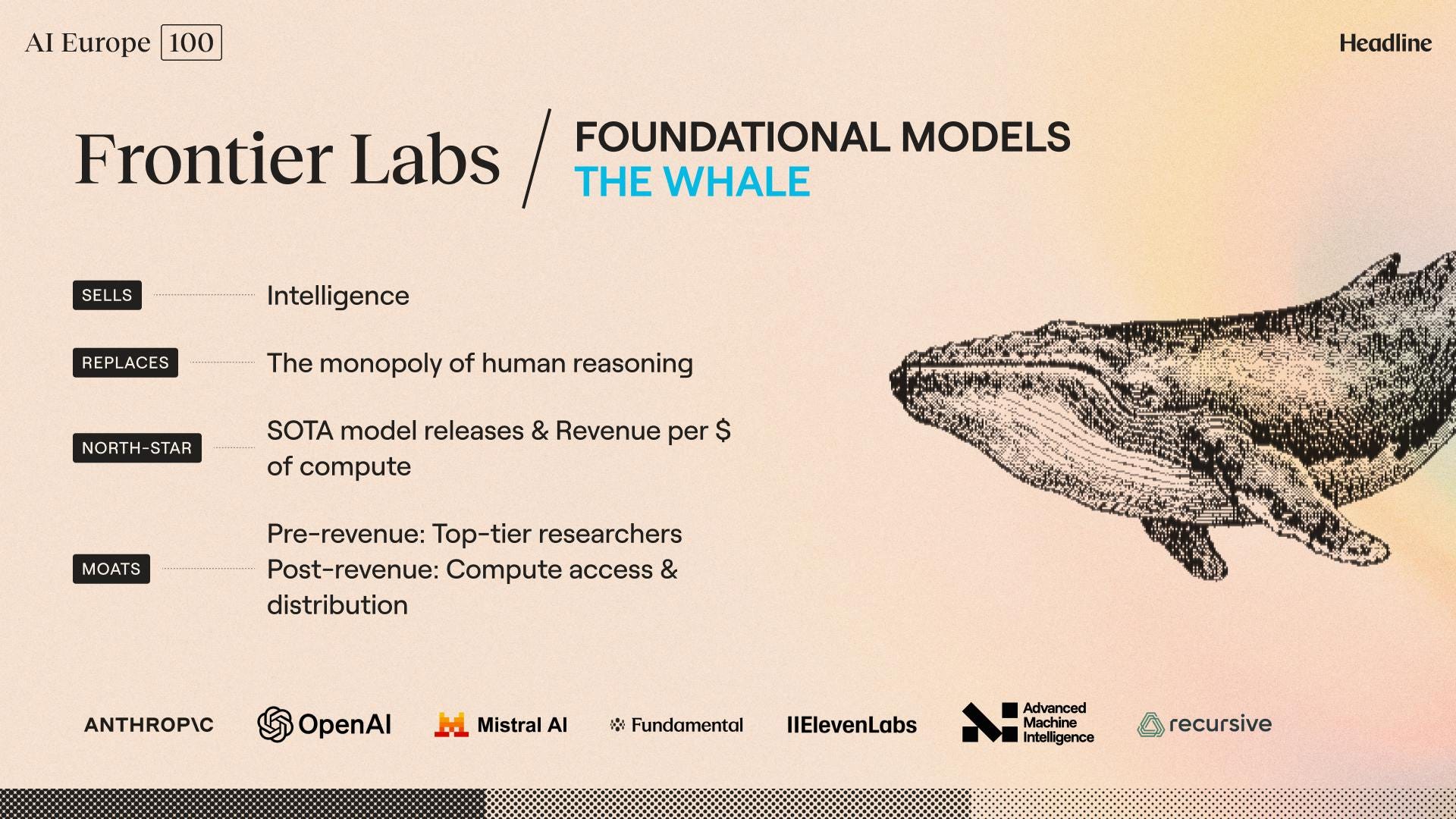
Foundational models · The Whale
Every other breed buys from, builds on, or defends against this one. Frontier Labs sell cognition itself, priced by the token, and the leaderboard resets with every release.
Overview
These companies are building the intelligence layer. The product improves in discrete jumps, each jump resets the competitive order, and the cost of staying in the race grows every round.
One breed, several frontiers
Foundation model does not mean language model. This breed is defined by selling the model itself, not by what the model processes. But each modality prices differently.
Text and reasoning. The largest TAM, the heaviest capital. OpenAI, Anthropic, Mistral, DeepSeek.
Image and video. The moat comes from distribution and consistent output. Benchmark scores matter less. Black Forest Labs.
Voice. The first modality settled by enterprise distribution rather than model quality. ElevenLabs.
World models. Models that predict the physical world: pre-revenue by design, priced on team and thesis. AMI Labs.
Scientific and tabular data. Biology, chemistry, tabular. Narrower TAM, deeper defensibility: proprietary data replaces scale as the barrier. Bioptimus. Fundamental.
The modality changes the diligence. The KPI does not.
Market dynamics
Winner-takes-most, never for long: the lead reshuffles every 3 to 12 months on release cycles.
States sit inside the demand curve. Sovereignty requirements, export controls, and national champions decide who buys, who sells, and at what price.
Business model
API revenue priced per token; margin tracks the inference cost curve.
Consumer subscriptions, ChatGPT, Claude, Le Chat: the second engine, and where the brand is built.
Sovereign and enterprise contracts: multi-year, custom, lumpy, and the hardest to displace.
Distribution
The broadest TAM on the map: developers, then prosumers, then enterprises and states.
Two clocks run at once: API adoption in seconds, sovereign deals in quarters.
ACV from cents per call to nine figures, inside one P&L.
Metrics
Revenue scaling 5 to 10x annually for category leaders.
Developers and prosumers defect on every rival release; enterprises stay once integrated.
Gross margins negative to thin. The breed is a bet that inference costs fall faster than prices.
Moats
Pre-revenue, the moat is talent: the labs that concentrate the best researchers get to exist.
Post-revenue, it shifts to compute access and distribution.
Capital is not a metric or a moat – none is defended by it.
Investor lens
Rounds are priced in billions. Getting access to one is the first constraint, ahead of judging whether to write the check.
Pre-revenue signal: the net flow of senior researchers, who leaves what to join whom.
Exits split in two: IPO for the winners, absorption for the rest. Sovereign consolidation is already the European pattern.
Risks: open weights closing the gap, model-layer commoditization, the reshuffle, unproven profitability.
Key examples
OpenAI: category-definer, agents, and consumer distribution.
Anthropic: enterprise traction.
Google DeepMind: vertical integration with Google distribution.
Mistral AI [EU]: European sovereign play.
ElevenLabs: voice.
Black Forest Labs [EU]: image generation leader.
Fundamental Technologies [EU]: tabular model.
AMI Labs [EU]: world models.
Bioptimus [EU]: foundation model for biology.
Recursive Intelligence [EU]: world models.
Ineffable [EU]: RL foundational model.
Stability AI [EU]: image and video models.
DeepSeek: Chinese, challenged the scaling orthodoxy.
02 · Velocity Racers
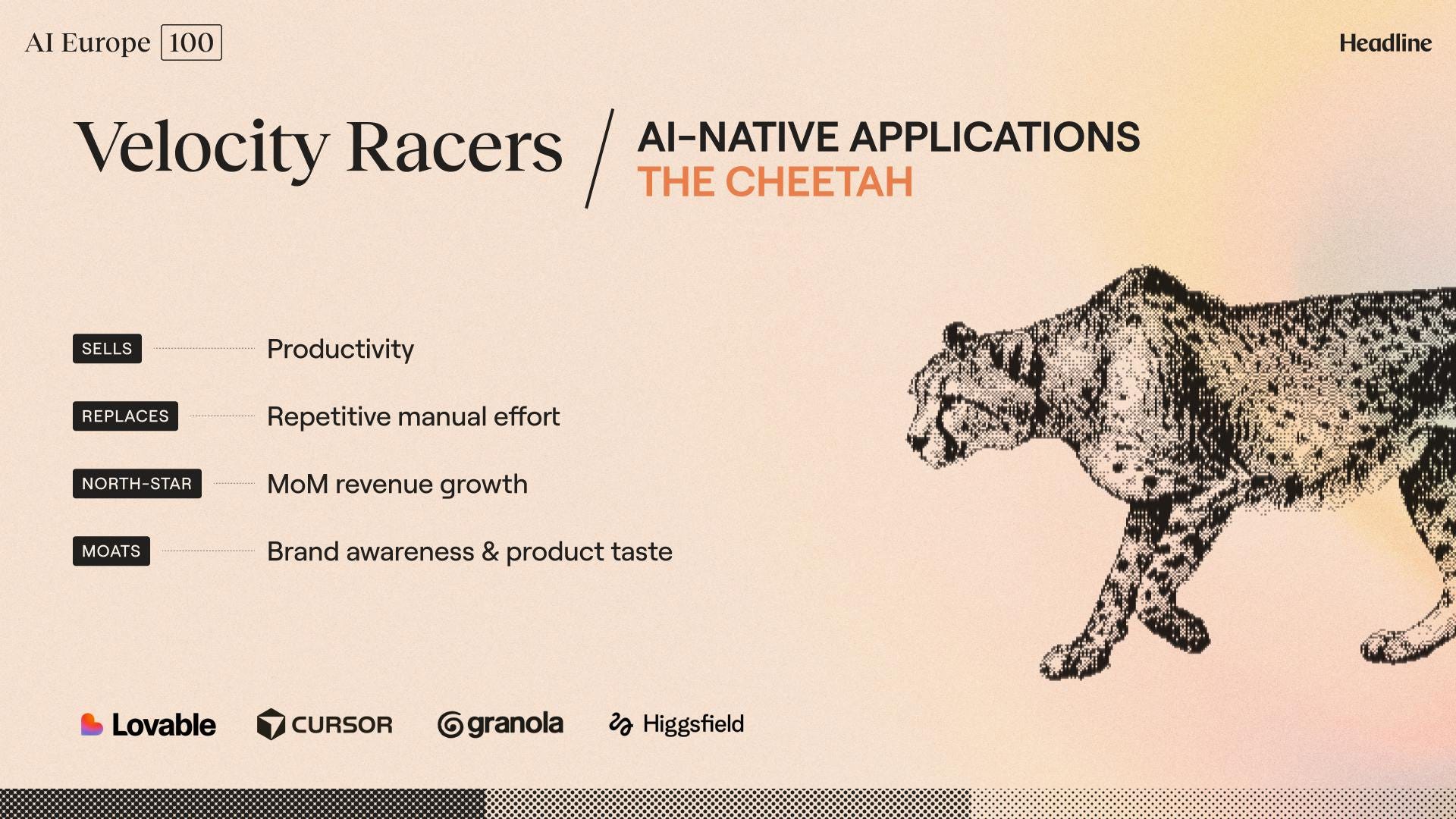
AI-native applications · The Cheetah
The fastest revenue curves in software history live here. So do the fastest collapses. Velocity Racers package AI into products that a user can adopt in minutes, though they can abandon those products just as quickly.
Overview
Self-serve, AI-native applications. The moat is rarely the model. It is iteration speed, product taste, distribution, and owning the value proposition in the user’s head.
Market dynamics
A category leader emerges in under six months, often on a single product moment.
Markets fragment fast: one clear leader, a long tail of replicas.
The US leads on volume; Europe wins selected niches.
Business model
Freemium and prosumer subscriptions, $10 to $50 per user per month.
Usage add-ons, credits and generations, as the expansion lever.
A light enterprise tier as the upsell path. Low ACV by default.
Distribution
ICP: consumers, prosumers, SMBs, individual professionals.
Sales cycle in minutes: self-serve, bottom-up.
ACV of $100 to $5K per account; virality compensates.
Metrics
$0 to $10M ARR in six to 12 months, $100M in 24, for the winners.
Retention is the structural weak spot: the wow-effect fades, novelty churn is real.
Burn multiples run high. Marketing spend buys mindshare, and mindshare is the asset.
Moats
Velocity itself: everyone ships weekly now, so cadence alone stopped being a real edge.
Brand: being the name the ICP associates with the job to be done.
Taste over technical depth: the founding team’s design sense matters more than the model choice.
Investor lens
Capital funds marketing and the perception of being the fundraising leader; both are self-reinforcing.
Exit: IPO for category leaders, acquisition for the rest.
Risks: feature-not-company, foundation model dependency, OS-level distribution capture.
Key examples
Lovable [EU]: the archetype; $0 to $100M ARR in eight months.
Cursor: AI code editor, $60B agreed sale to SpaceX (Jun 2026).
DeepL [EU]: translation, the quiet compounder of the breed.
Synthesia [EU]: AI video for enterprise.
Granola [EU]: meeting notes, prosumer wedge.
Higgsfield: AI video and creative generation.
Perplexity: consumer search repositioning toward browser and enterprise.
Midjourney: AI image generator, early category-definer, still independent.
03 · System Builders
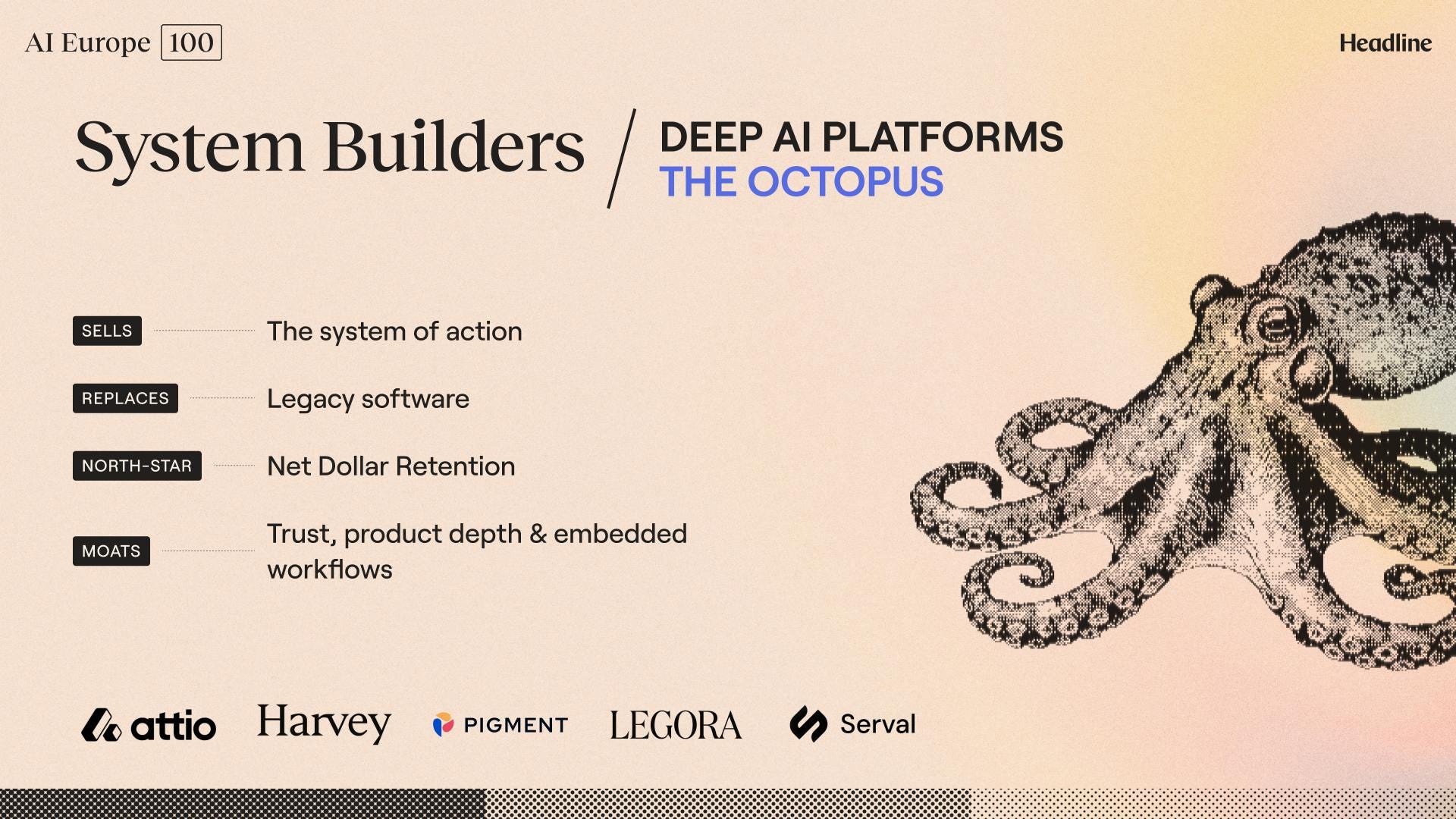
Deep AI platforms · The Octopus
The next ERPs, CRMs, and operating systems are being written now. System Builders replace the software an enterprise runs on.
Overview
The playbook is land-and-expand: enter through a wedge, spread into the platform. Harvey from document review, Glean from search, Legora from drafting. Once the workflows, data, and habits move in, it’s difficult to pull these systems out.
Market dynamics
Every legacy category is under attack: ATS, CRM, EHR, legal tech, ERP modules.
The window is set by the incumbents: entrench before Salesforce, SAP, and Microsoft ship good-enough agents into their installed bases.
Compliance shapes procurement: SOC2, HIPAA, ISO, FedRAMP are the tickets to the table in regulated verticals.
Business model
Per-seat subscriptions: the customer pays for access to the tool, regardless of how much work it actually does.
Tiered platform pricing: modules, add-ons, and premium support drive expansion.
Consumption and outcome pricing are eroding the per-seat default from inside the breed.
Distribution
ICP: mid-market and large enterprises, regulated verticals first.
Sales cycle of six to 12 months, multi-stakeholder.
ACV from $100K to several million, expanding with seats and modules.
Metrics
Growth is slow, then violent: Harvey went from $50M to $190M ARR in 12 months.
NDR of 130%+ marks the best, and drives most of the long-term value.
Gross retention of 95%+ once embedded. What makes switching costly is how deeply the product sits in daily operations; the contract terms barely factor in.
Moats
Workflow embedding: data, integrations, and user habits compound into stickiness.
Compliance and trust: earned barriers new entrants cannot shortcut.
A double talent bar: enterprise sales DNA and AI research credibility, both required, rarely found together.
Investor lens
Capital-hungry: the enterprise sales ramp is slow and expensive before it compounds.
Exit: IPO for category leaders, strategic M&A by enterprise incumbents.
Risks: incumbents shipping good-enough AI, and implementation drag that stalls the expand motion.
Key examples
Harvey: legal, category-definer.
Legora [EU]: legal, contender.
Glean: enterprise search and work assistant.
Attio [EU]: new-generation CRM.
Pigment [EU]: France, AI-native planning.
n8n [EU]: workflow automation.
Sana [EU]: learning and knowledge.
Serval [EU]: AI-native IT operations.
Payflows [EU]: new-generation ERP.
Aikido [EU]: security platform.
Abridge: healthcare documentation.
Pelico [EU]: AI-enabled manufacturing operations.
04 · Outcome Engines
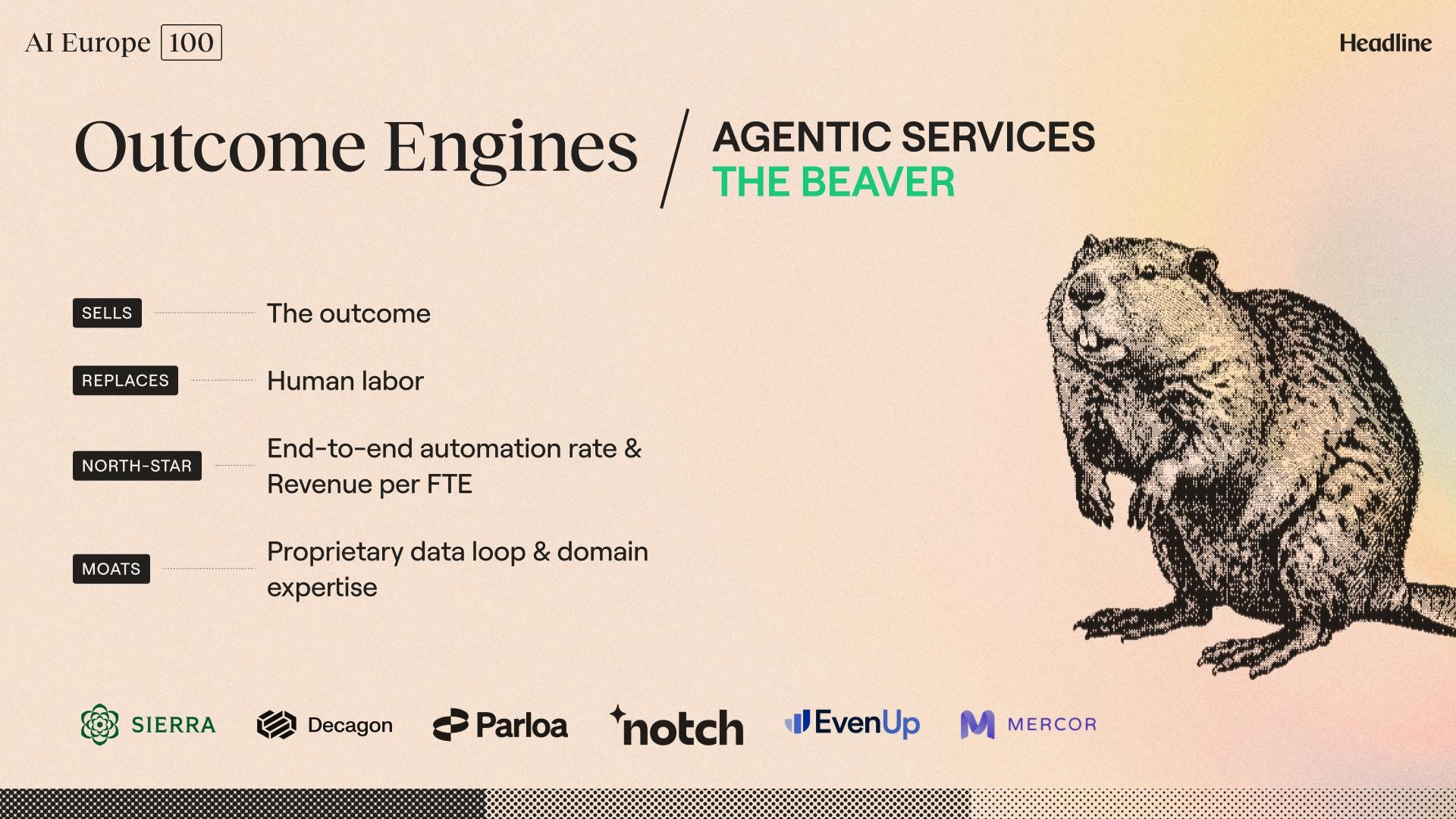
Agentic services · The Beaver
The customer does not buy software here. It retires a cost line. Outcome Engines absorb a function and bill for the result.
Overview
The thesis is all about labor compression: AI shrinks the cost of delivering a result faster and spreads throughout the business. If the compression stalls, what remains is a services company at services multiples.
Market dynamics
The targets are labor-intensive functions: customer service, claims, sales development, recruiting.
The legacy enemy is the services incumbent, where a 10x cost reduction is on the table.
ROI is measured against an existing budget, so the sale closes faster than any software deal.
Business model
Per-outcome pricing: per resolution, per claim processed.
Performance contracts: SLAs on volume, quality, and response time.
Hybrids emerging: retainer plus a per-outcome premium tier.
Distribution
ICP: any company running a labor-heavy function, mid-market to large enterprise.
Sales cycle of two to six months, shorter than System Builders, because the ROI is arithmetic.
ACV scales with the volume of work absorbed: $50K to multi-million.
Metrics
Growth follows the proven SLA; account expansion follows the automation rate.
Gross margin starts at 30 to 50% and climbs toward 70 to 85% as automation rises.
The automation curve is the whole story. Flat curve, services multiple.
Moats
Operational excellence: delivering the outcome reliably at scale is harder than building the model.
Data flywheel: every interaction trains the system that handles the next one.
Domain depth in the target vertical, which generalist AI cannot cross quickly.
Investor lens
Moderate capital: revenue can fund growth when the model holds.
Exit: M&A by service incumbents, IPO if margins prove software-like.
Risks: SLA failure is binary, and if the automation rate stalls, the company gets re-rated as a services business rather than just slowing down.
Key examples
Sierra: customer service, category-definer.
Decagon: customer service.
Parloa [EU]: AI contact center.
Mercor: recruitment and talent matching.
Notch: complex support for regulated industries.
EvenUp: legal claims, performance-based.
05 · Stack Enablers
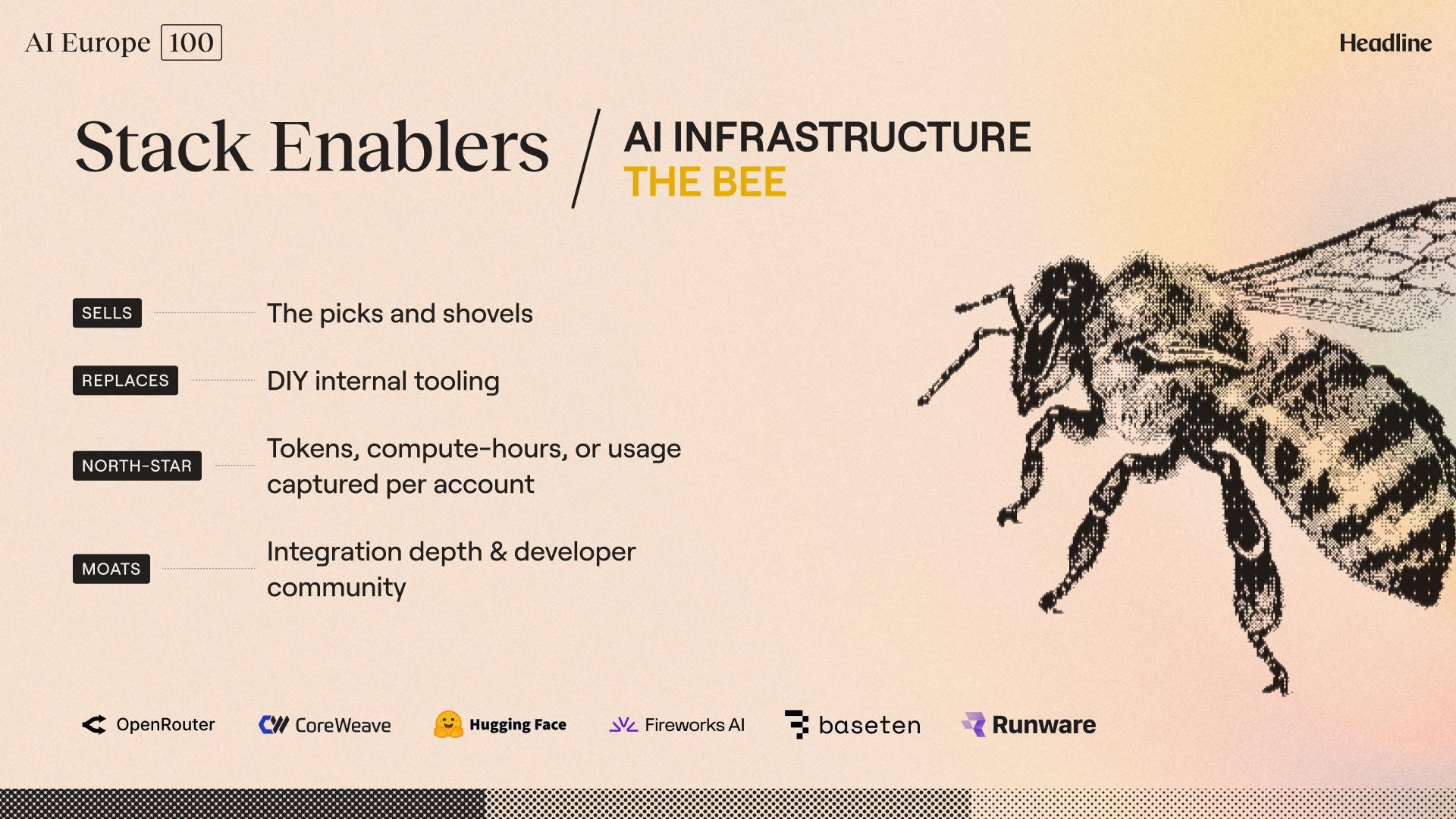
AI infrastructure · The Bee
Stack Enablers sell to all players and grow with the sum.
Overview
Three sub-layers, three economics: compute and serving, data and training, dev tooling and orchestration. What they share is the position: everyone else’s growth is their revenue.
Market dynamics
Revenue indexes on total AI consumption, which keeps compounding regardless of who wins above.
The prize is default status: becoming the standard in a developer workflow beats any single contract.
The squeeze comes from both directions: labs integrate down, tooling consolidates up.
Business model
Usage-based dominant: tokens routed, compute provisioned, experiments run.
Capacity reservations: long-term contracts locking GPU supply for labs and hyperscalers.
Freemium and open source for dev tools; production usage and team features convert.
Distribution
ICP: developers, labs, hyperscalers, enterprises deploying AI internally.
Minutes for a dev tool, 4 to 12 months for an enterprise contract.
ACV from a few dollars to nine-figure deals.
Metrics
Consumption growth per account, compounding with total token demand.
Gross margin moderate on compute, mixed on data, best in tooling.
Retention is high once embedded: churning means running a migration project.
Moats
Integration depth: unwinding it means staffing an engineering project. A renewal call won’t do it.
Developer ecosystem: community, standards, and default-tool status.
Investor lens
Capital: billions for compute, moderate for data and tooling.
Exit precedent set by CoreWeave’s IPO (Mar 2025); M&A by hyperscalers and data platforms for the rest.
Risks: vertical integration from above and below, and demand concentrated on a handful of labs that can become competitors.
Key examples
CoreWeave: GPU cloud, IPO Mar 2025, acquired Weights & Biases (May 2025).
OpenRouter: model routing and aggregation.
Together AI and Fireworks AI: open-model inference.
Hugging Face: the standard model repository.
Nscale [EU]: AI infrastructure.
Fluidstack: AI compute.
Baseten: model deployment and serving.
Runware: media-generation inference.
Dataiku: data science and AI platform.
Dash0 [EU]: observability.
Langfuse [EU]: open-source observability.
06 · Intelligent Hardware
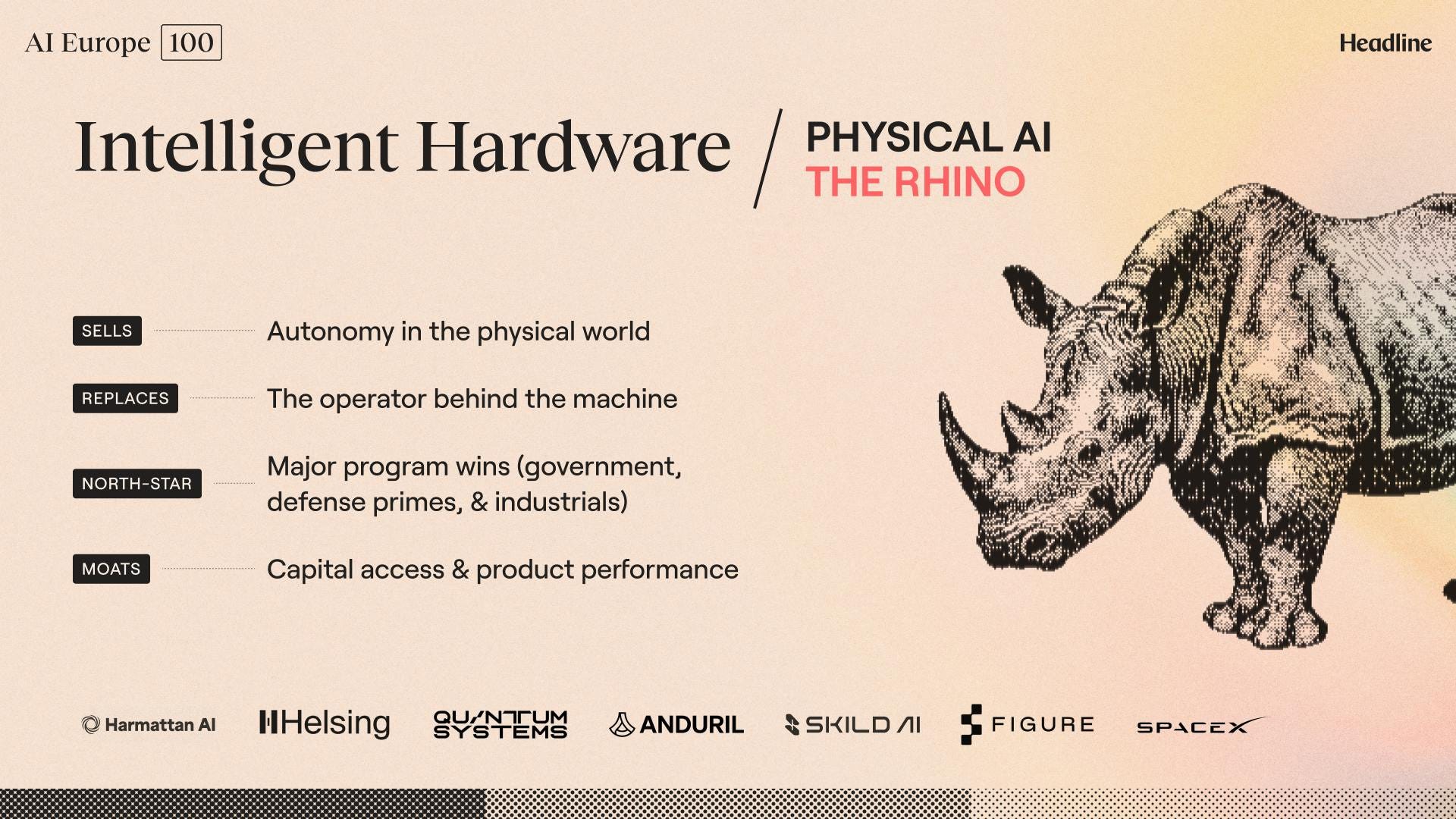
Physical AI · The Rhino
Intelligent Hardware embeds autonomy into machines and sells it through the slowest, most protected procurement on earth. That slowness is the moat.
Overview
Robotics, autonomous defense, space, and dual-use hardware. Capex-heavy, regulation-bound, and geopolitical by construction.
Market dynamics
Sovereign demand is the engine: national security budgets drive the largest contracts.
Development cycles run three to 10 years from concept to deployment.
ITAR, export controls, and EU defense rules define what can be built and sold, and to whom.
Business model
High-unit-cost hardware sales: drones, robots, satellites, ground systems.
A software overlay, autonomy stack, data services, fleet management, adds the recurring layer.
Multi-year government programs with milestone-based payments.
Distribution
ICP: defense ministries, prime contractors, space agencies, industrial conglomerates.
Sales cycle of 12 to 36 months, RFP-driven, longer for defense and space.
ACV in the millions to hundreds of millions; nine-figure single contracts happen.
Metrics
Growth is lumpy and tied to individual contracts rather than a steady monthly recurring line.
Gross margin swings with the hardware-to-software mix.
Backlog and program wins lead revenue. ARR is the wrong lens in this breed.
Moats
Manufacturing, supply chain, and certification: years to replicate, impossible to shortcut.
Security clearances and trusted-vendor status act as structural barriers; no amount of competing on price gets around them.
Autonomy tuned to the specific physical system, hard to copy across platforms.
Investor lens
Capital: hundreds of millions to billions across the lifecycle.
Exit: IPO for the largest; M&A by primes for the rest.
Risks: program cancellation, geopolitical exposure, capex overruns, certification delays.
Key examples
Anduril: autonomous defense, category-definer.
Helsing [EU]: defense AI, category-definer.
Harmattan AI [EU]: autonomous defense drones.
Quantum Systems [EU]: dual-use drones.
Stark [EU]: autonomous defense systems.
Wayve [EU]: end-to-end autonomous driving.
RobCo [EU]: industrial robotics.
Wandercraft [EU]: exoskeletons and the Calvin industrial humanoid.
Skild AI: foundation models for robotics.
Figure AI: humanoid robotics.
SpaceX: launch and orbital infrastructure.
Reading the map
From taxonomy to thesis: where value is created, threatened, and mispriced.
The six breeds are a sorting tool. What follows is the thesis: the memory system that makes the grid stick, where capital buys defensibility and where it cannot, how margins travel as each breed scales, which migrations between families create or destroy value, and what the map says about Europe.
The Animals
The animals are a memory system: each one chosen because its actual biology encodes the breed’s economics. Remember the animal, and you remember what to diligence.
01 · The Whale. The largest creature in the ocean feeds by filtering colossal volumes of the smallest target. Its whole economic problem is turning that intake into mass, and that’s the animal problem too, just with computing power instead of plankton. Whales are few, they’re tracked by name, and every time one surfaces it makes the news, much like a model release does. A whale can’t survive in a small habitat; it needs an ocean, and a frontier lab needs an entire capital ecosystem to match.
02 · The Cheetah. Zero to a hundred in three seconds. This breed runs zero to $100M ARR on roughly the same timeline. Everything in the cheetah’s body is built for acceleration and nothing is spare: taste over technical depth rendered in anatomy. It is also the most photogenic predator on the savanna, the one everyone wants on camera, which is the moat itself: brand, mindshare, being the animal people think of first. But top speed holds thirty seconds, and after the sprint the cheetah rests while lions steal the kill. Its weakness is endurance. The breed’s weakness is retention: you can win the hunt and still lose the meal.
03 · The Octopus. Eight arms, eight workflows: land with a wedge, then expand limb by limb. Net Dollar Retention (NDR) is essentially a count of how many arms are still gripping, and once the suckers attach, removal turns into surgery. Two-thirds of an octopus’s neurons live in its arms rather than its head, so intelligence sits distributed across every module. It also camouflages itself to whatever environment it’s in, much as a platform deeply integrated into its clients’ architecture.
04 · The Beaver. The only animal besides man that engineers its own habitat. What you’re paying for is the dam, never the hours the beaver spends on it: the pond is the outcome, the labor stays invisible. A dam holds water or it fails, and that binary is close to what an SLA measures. And every dam the beaver builds teaches it to build the next one faster: experience compounds, which is the data flywheel in one image. Each season the same dam takes less labor to maintain, and that is the automation curve, playing out one pond at a time.
05 · The Bee. A single bee is unremarkable. The colony is everything. Each bee works the entire field instead of betting on one flower, which is exactly how a Stack Enabler behaves: it captures a sliver of consumption from every AI infrastructure and compounds. Bees pollinate crops that they will never own. And a hive defends itself through structure and standards, just as integration depth and default status make switching feel like relocating an entire colony.
06 · The Rhino. It wins through mass, armor, and momentum, never agility. The armor is the moat: certifications, government contracts, manufacturing capacity, all built up exactly where threats land. Rhinos are among the most geopolitically protected animals on earth, guarded by treaties, armed escorts, sovereign custody, and that’s roughly what it feels like to operate inside ITAR and export controls. They’re territorial too: a program win is a waterhole, claimed and defended.
Capital × Moat
Where capital deepens the moat, and where it cannot.
Plot the six breeds on two axes: capital required on the horizontal, moat defensibility today on the vertical.
One definition first, because the axis fails without it. Capital required is the structural entry barrier: what it costs to exist in the breed at all. It is not burn, which is discretionary go-to-market spend. Velocity Racers burn enormously and require little.
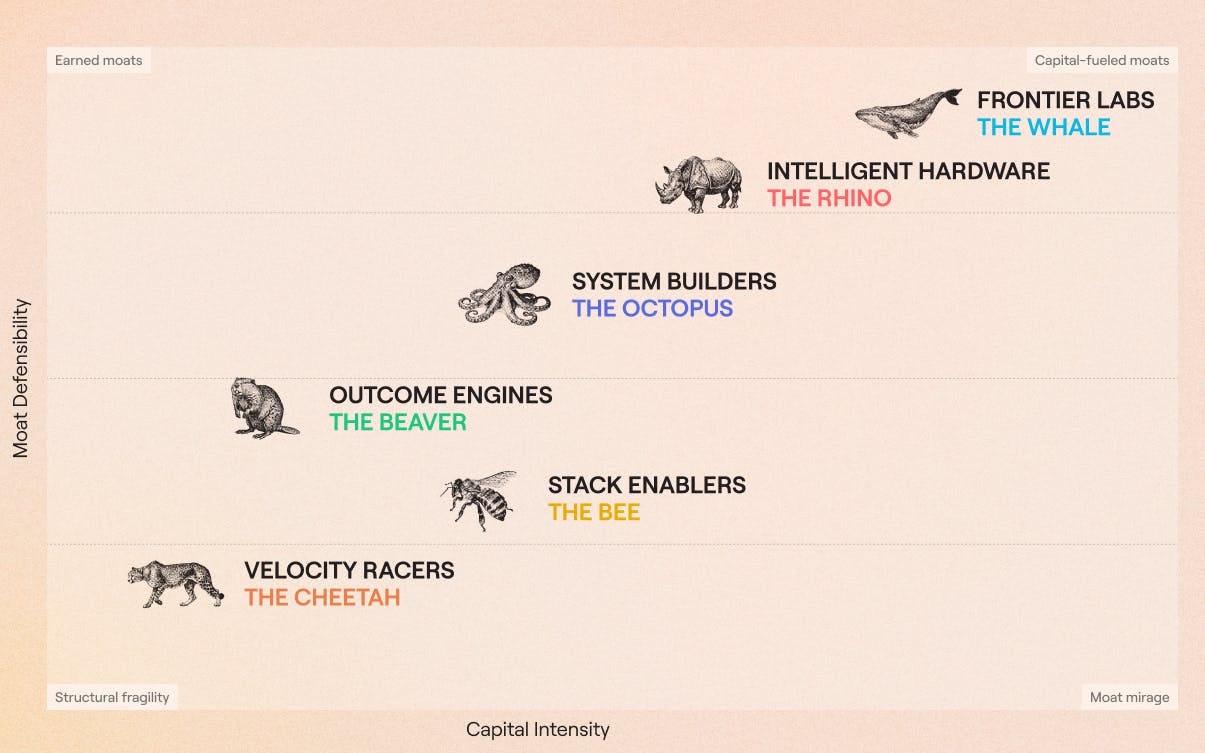
Read the board corner by corner:
Frontier Labs, top right. The most capital spent and the highest perceived moat on the board, and the most contested position on it. On our read, the model layer is commoditizing: open weights compress the frontier premium, and each release cycle gives challengers a fresh shot. The moat is real today and rented by the quarter.
Intelligent Hardware, just below. The one breed where capital reliably converts into defensibility, because it buys things competitors cannot shortcut: certifications, program access, manufacturing, clearances. Slower to win, harder to displace. The most durable moat on the board.
System Builders, Outcome Engines, Stack Enablers, the middle. Moats here are earned, not bought: embedded workflows, data flywheels, integration depth. Capital accelerates the earning; it cannot substitute for it. A competitor with twice the funding and none of the embedding is not ahead.
Velocity Racers, bottom left. Modest capital required, weak structural moat. This isn’t a flaw; it’s the breed design. Spending more money doesn’t get a company out of this corner. Migrating to a different breed does, and that’s what the next section maps.
Top right is capital-fueled moats, top left is earned moats, bottom left is structural fragility. Bottom right, high capital and low defensibility, is the moat mirage: the most expensive mistake on the board, and where a Frontier Lab lands if commoditization outruns its revenue conversion. The reading rule for an investor: price the moat trajectory, never the capital deployed. Capital tells you who could afford to enter. The moat tells you who gets to stay.
Margin trajectories
Where margin compounds the most, and where it is capped.
Gross margin here means margin after inference, compute, and human-in-the-loop costs, including training amortization and depreciation. Two numbers per breed, today and expectations at scale, and two forces per breed: what pushes margin up, and what caps it. These are rough estimates to give orders of magnitude.
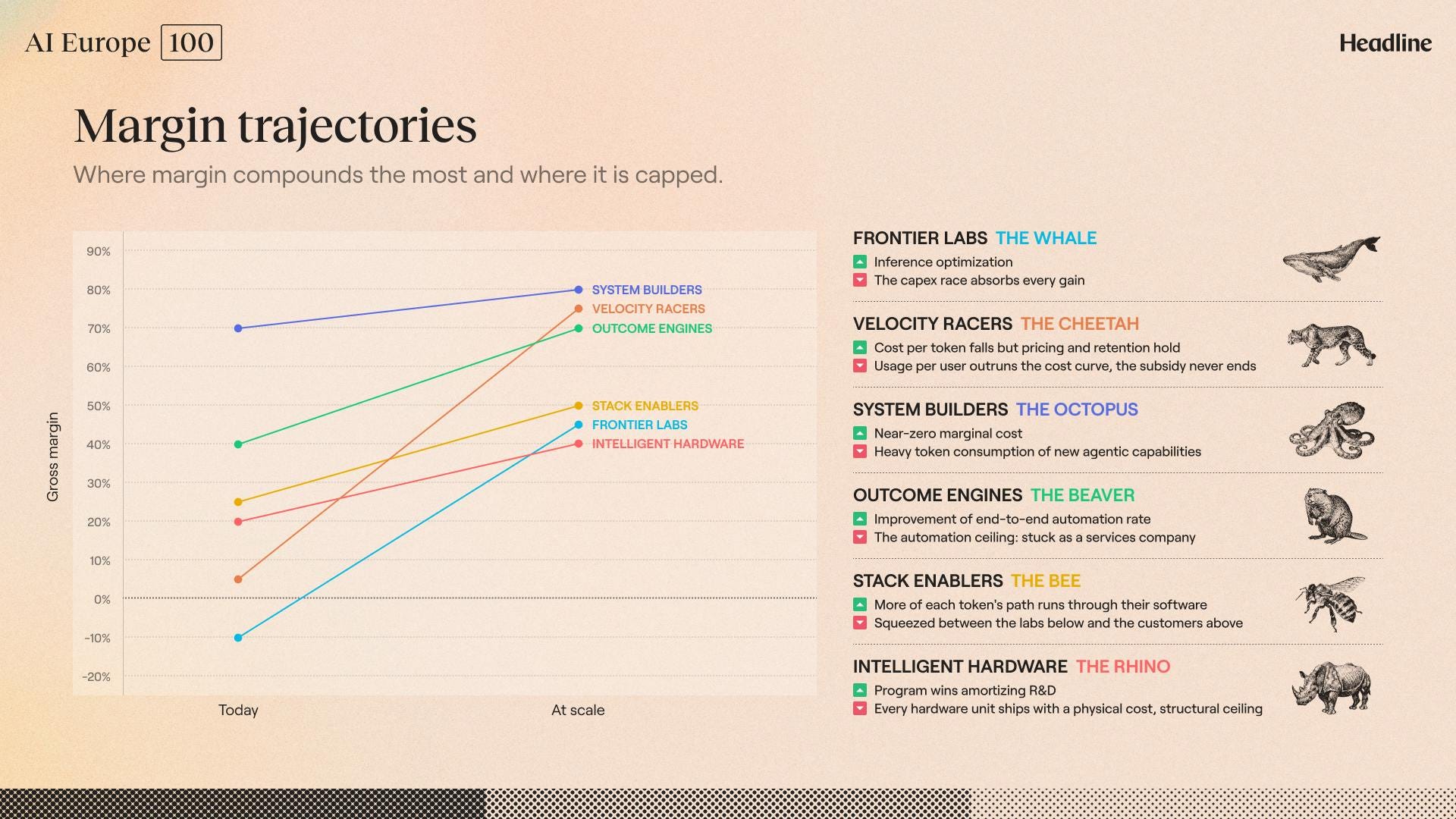
Three readings matter more than the levels.
First, the steepest slopes belong to the two families where the up-scenario is least guaranteed. Frontier Labs travel from a negative margin to 45% only if inference optimization outruns the capex race, and so far, the race is winning. Velocity Racers reach 75% only if pricing holds while usage explodes, and the breed’s own history says users consume faster than costs fall.
Second, System Builders start where everyone else hopes to arrive. 70% today, 80% at scale: software economics from day one. The threat is internal, agentic features that consume tokens faster than they add price. The System Builders margin question is not whether the margin can increase, it is whether the new capabilities pay their own way.
Third, two breeds have ceilings built into their physics. Outcome Engines cap where their automation rate caps: the residual human in the loop is a permanent cost of goods. Intelligent Hardware caps because every unit ships with atoms in it. Neither ceiling is a flaw; both are prices of admission to markets software alone cannot reach. The mistake is paying software multiples for capped-margin businesses, which brings us to migrations.
The migration map
The map is not static. Breeds build defensibility by migrating product or pricing.
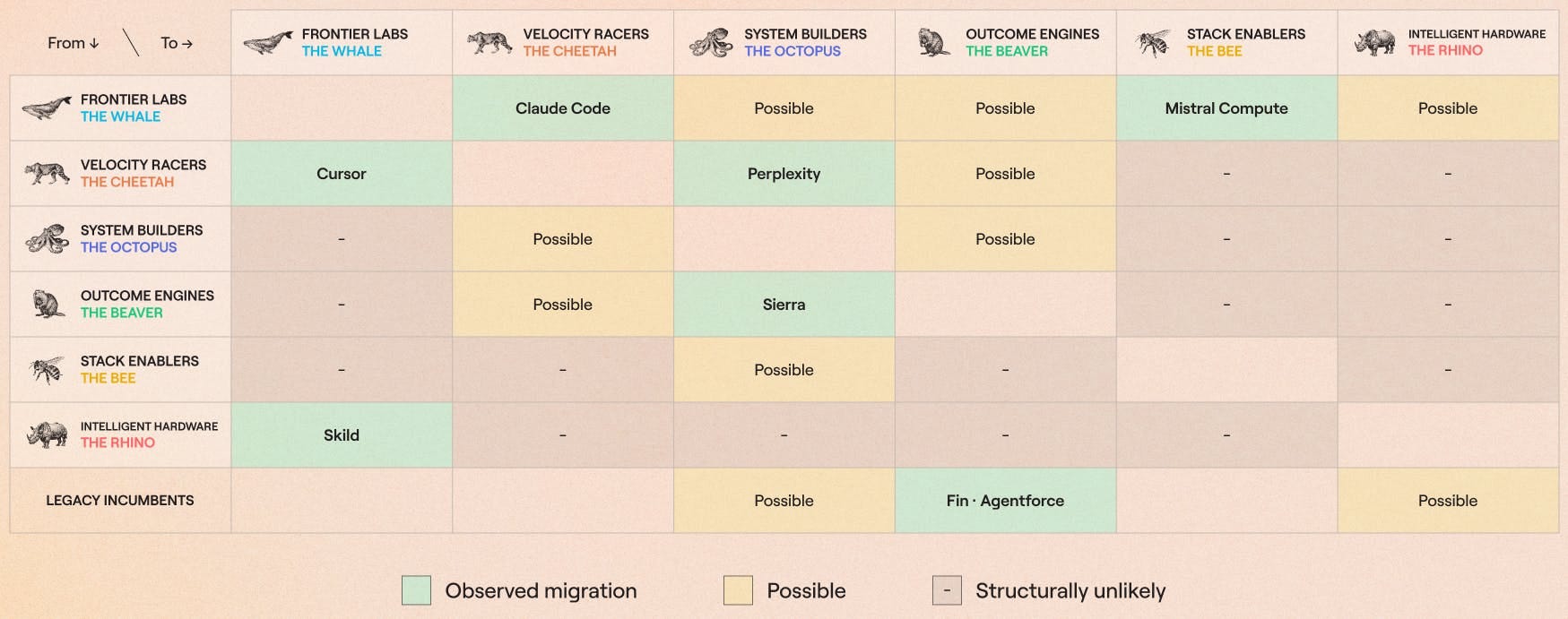
A breed describes a company’s current state. It isn’t a fixed identity. Companies are classified by their dominant revenue engine, and that engine can change. When it does, the valuation re-rates on how credible the migration looks, often well before the migration is finished. So the question that matters most in diligence isn’t which box a company sits in today. It’s which arrow it’s moving along.
The value paths
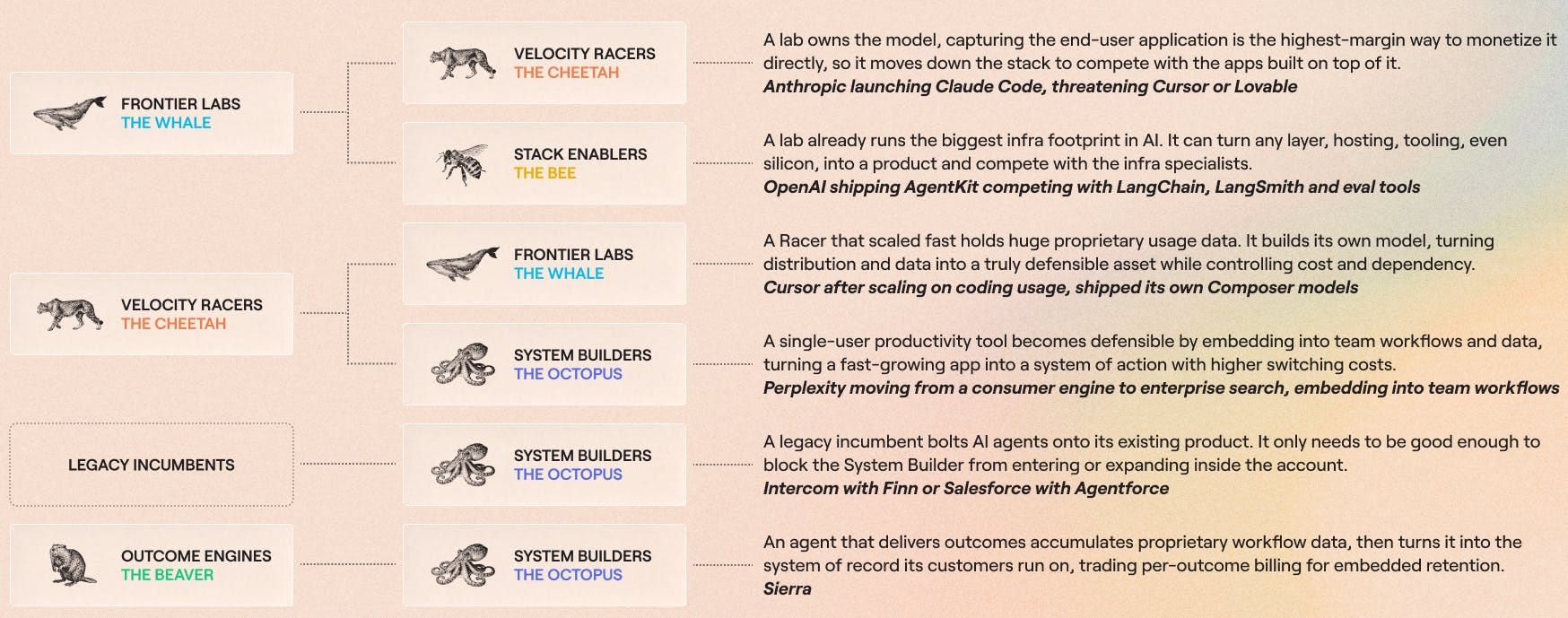
02 → 03. The golden path. Enter with Velocity Racer economics, self-serve adoption, and explosive top line, exit with System Builder economics, enterprise NDR, and platform multiples. It cures the breed one structural disease, novelty churn, by replacing it with workflow embedding. Cursor is the documented case: a product that entered the arrow on prosumer subscriptions exited with enterprise accounting for roughly $2.6B of its ~$4B annualized revenue by June 2026. It will not end the journey independently: SpaceX agreed in June 2026 to acquire it for $60B in stock, the largest acquisition of a venture-backed startup on record, expected to close in Q3. Perplexity is attempting the same migration, in full view of the incumbents it threatens, moving from consumer answer engine to enterprise search embedded in team workflows, and Lovable is a step earlier. The signals appear in a fixed order: pricing shifts from seats and credits to platform tiers, compliance certifications land, forward-deployed hiring accelerates, and only then does the ARR mix move. The failure mode is equally observable: an enterprise tier launches and the mix does not move within four quarters. That company is a Velocity Racer carrying a System Builder price, the single most common mispricing in this market.
02 → 01. The model flip. A Velocity Racer that scaled fast holds something labs covet: proprietary usage data at volume. Building its own model converts distribution and data into a defensible asset while cutting cost and dependency. Cursor shipped its Composer models after scaling on coding usage. The honest nuance for a technical room: Composer was built on an open-weight base rather than trained from scratch. That’s precisely the point. Open weights made the arrow affordable; the proprietary data and distribution made it worth taking.
04 → 03. The embedding flip. An agent that delivers outcomes accumulates the customer’s workflow data, then turns into the system of record the customer runs on, trading per-outcome billing for embedded retention. Sierra or Notch are the cases to watch, expanding from resolutions into an Agent OS. Discipline requires saying it plainly: no Outcome Engine has yet completed the flip to platform-dominant revenue. It is an emerging pattern, not a proven one, yet!
The threat paths
01 → 02. Labs eating the app layer. A lab owns the model; capturing the end-user application is the highest-margin way to monetize it, so it moves down the stack against the apps built on top of it. Anthropic shipping Claude Code against Cursor and Lovable is the live case, and the damage is measurable: Cursor’s share of AI coding spend fell from 41% to roughly 26% in under a year on Ramp’s data, with Anthropic taking half the category. The distribution variant is more brutal still: Apple Intelligence, Gemini in Android, Copilot in Windows can erase a Velocity Racer niche at the OS level overnight. The defense is the golden path itself: embed into workflows before the lab arrives.
01 → 05. Labs reselling their own infra. A lab already runs one of the largest infrastructure footprints in AI, and can turn any layer of it into a product: OpenAI’s AgentKit against LangChain, LangSmith, and the eval tools; Mistral Compute against the GPU clouds. The squeeze lands on pure-play inference and orchestration, whose largest suppliers become their competitors. Demand concentration makes it existential: when a handful of labs are most of your revenue, any one of them integrating down can end you. This is why OpenRouter’s risk profile differs structurally from Together’s or Fireworks’: every new competitive model adds traffic to a router and subtracts pricing power from an inference provider.
Legacy incumbents → 03. The counter-migration. The one arrow that enters the map from outside it. Intercom with Fin, Salesforce with Agentforce: the incumbent bolts agents onto its installed base, and it does not need to win. It needs to be good enough to block the System Builder from entering or expanding inside the account. This is the existential clock on breed 03, and the reason the window to entrench is the narrowest constraint in the map.
The arrows that do not exist
Some migrations are structurally unlikely, and knowing why sharpens the map. A System Builder does not become a Velocity Racer: enterprise embedding does not reverse into self-serve simplicity, and no one has ever un-implemented themselves into virality. An Intelligent Hardware company does not migrate into software families: its moat, certifications, clearances, manufacturing, is precisely the asset that does not transfer. And almost nobody migrates into breed 01 from outside breed 02: without proprietary usage data at scale, the arrow has no fuel. When a pitch claims one of these arrows, the burden of proof is on the pitch.
What migration does to price
Three patterns recur. The multiple re-rates before the revenue mix does: investors pay the destination breed price on credibility, which is where both the upside and the mispricing live. Migration announcements cluster around fundraises: the enterprise-pivot narrative and the round arrive together, so discount the narrative and audit the mix. And the contested exits sit on unfinished arrows: Outcome Engines will be priced as software or services depending on where automation rates settle. The practical rule: classify the company by its current dominant revenue engine, then underwrite the arrow. The breed tells you what you are buying today. The arrow tells you what you are paying for.
The European read
European sovereignty in AI is real but uneven, and the map is sharpening rather than filling in. Europe is now genuinely strong in three breeds, and the white space in the other three is just as instructive.
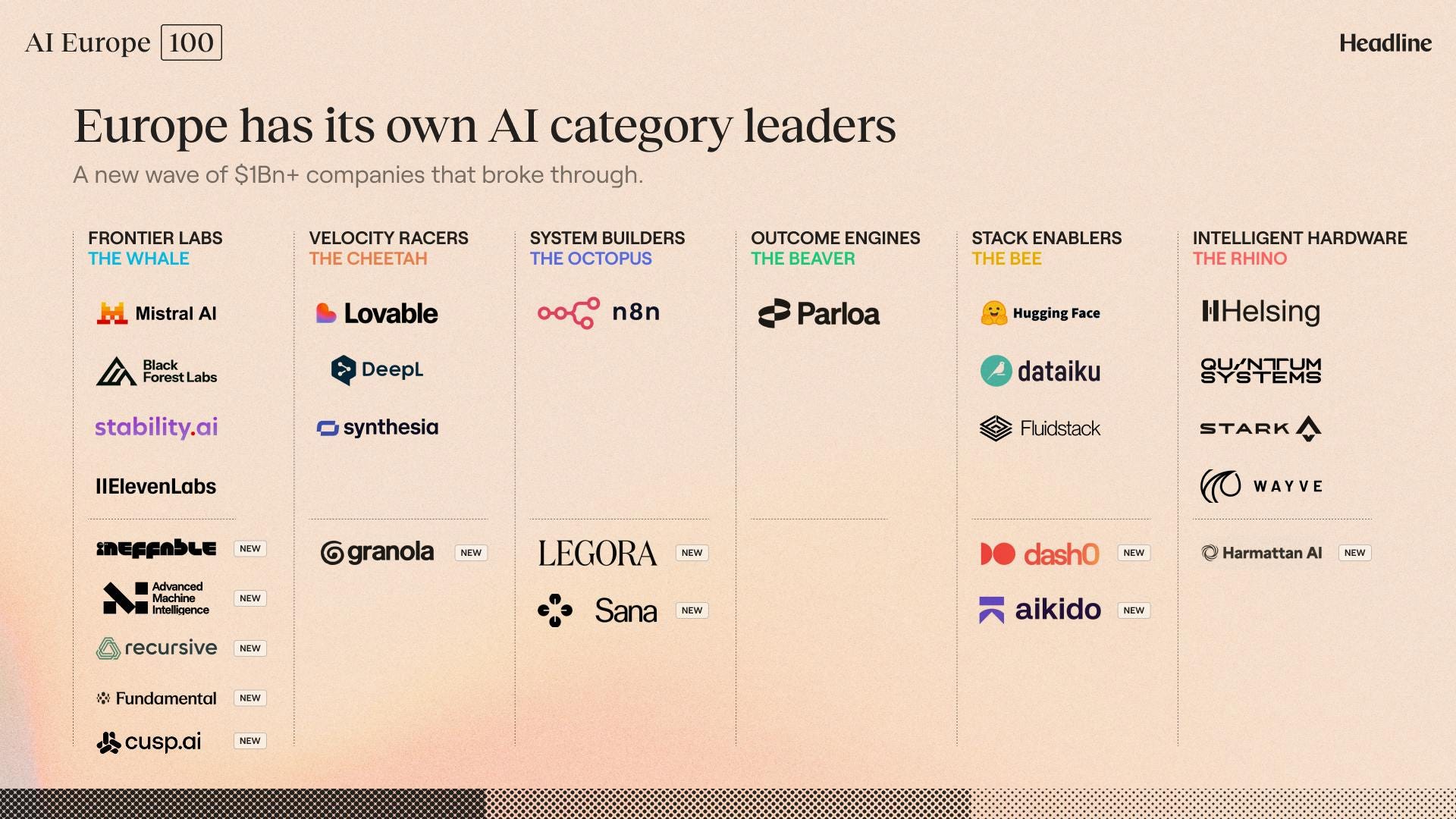
Where Europe is strong.
European sovereignty in AI is real, but it’s uneven, and this year that unevenness is easier to see than it was twelve months ago.
Frontier Labs: Mistral, AMI Labs, Recursive Intelligence, Fundamental, Gradium, ElevenLabs, Black Forest Labs, Ineffable, Stability, Bioptimus, and a deepening bench behind them.
Velocity Racers: Lovable going from zero to $400M ARR in under two years is the archetype for the whole breed globally, with DeepL, Legora, Synthesia, and Granola right behind it.
System Builders is where the AI Europe 100 2026 actually centers: more than 40% of this year’s 100 companies. That’s not an artifact of how the list was put together. Europe’s enterprise market rewards exactly what this breed does well: regulated verticals, compliance-heavy procurement, and legacy software fragmented by country and language, which buys local entrants time to dig in before a global winner shows up.
The cohort is wide. Attio is rebuilding the CRM from London. Wordsmith raised a $70M Series B to become the system in-house legal teams run on, with BT, Canva, and the Financial Times among its customers. Maki runs enterprise hiring end-to-end on top of the ATS for H&M, BNP Paribas, and FIFA, while Nevis, founded by Revolut alumni, raised $35M from Sequoia to build the operating platform for US wealth advisors. Trawa is doing to energy procurement what these companies did to legal software, and Primo is doing the same for SME IT.
Intelligent Hardware is Europe’s most uneven category right now. European defense, security, and resilience startups raised a record $8.7B in 2025, up 55% year over year, with AI underpinning 44% of that funding (Dealroom / NATO Innovation Fund). The top of the breed has re-priced to match: Helsing is raising at an $18B valuation, Harmattan is at $1.4B with Dassault Aviation leading and French and UK MoD orders within two years of founding, and Quantum Systems is close behind.
The frontier is consolidating, not fragmenting. Cohere’s acquisition of Aleph Alpha, announced in April 2026 and still subject to regulatory approval, would create a $20B transatlantic sovereign-AI group with Cohere holding roughly 90% of the combined entity. If it closes, Mistral becomes Europe’s only independent frontier LLM developer left standing. Sovereign consolidation looks like the exit path for frontier labs that don’t win the race outright.
Then there’s the white space. Stack Enablers remain thin: Nscale is the standout, Hugging Face is French-founded but US-incorporated, Fluidstack pivoted to the US, and the tooling layer barely registers.
Outcome Engines barely exist at scale either. Parloa is nearly alone at the top, though a small cohort is forming underneath it.
There’s a bigger capital problem behind all of this. Europe matches the US on talent and on startup creation, and still trails it by a wide margin on late-stage capital, roughly $12B against $141B. The same gap runs through defense: even after a record year, US investors still account for the large majority of NATO-ally defense-tech ventures, much of it concentrated in exactly the late-stage rounds Europe can’t yet write on its own. Europe is good at sourcing deals and building companies. Getting those companies to scale globally is the piece still missing.
That gap is real, and so is the momentum behind it. Europe isn’t scanning for signs of life anymore, not in the categories that work. It’s picking among four families where it already has category leaders, while a hundred companies fight over what the next generation of those leaders looks like.
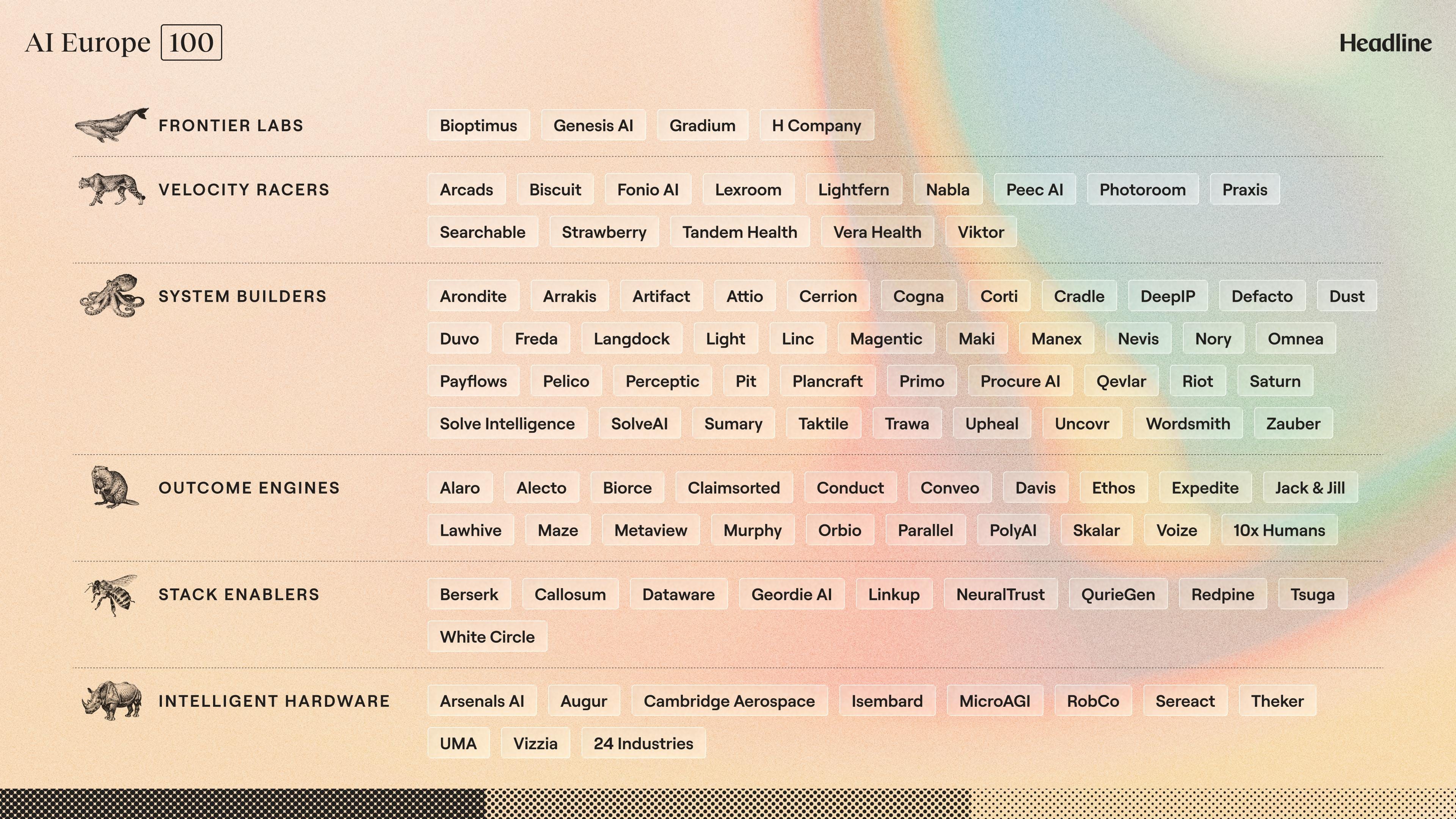
Outside the frame, deliberately. Three deliberate exclusions. AI biotech spends like a Frontier Lab but exits on pharma economics. Crypto × AI plays by different rules and deserves its own map. AI consulting is a massive market, mostly outside venture, yet it shapes how every breed here gets adopted.
Disclaimer: Headline and its affiliated funds may hold positions in companies mentioned in this post. This post is for informational purposes only and does not constitute investment advice. Figures cited reflect publicly available information as of July 3, 2026.
