


The debate over European competitiveness may seem abstract, but in fact it is existential to the future of the continent. Europe needs growth. It needs growth in order to pay for more defense, which has seen years of underinvestment. The population is aging, putting upward pressure on health spending. Without faster productivity growth, Europe will be forced into hard choices, between higher taxes, weaker welfare states, and higher debt.
The challenges facing Europe are well-documented. However, as investors with a foot in both the US and Europe, we believe that we are well-placed to comment on the progress that Europe is making. Europe faces a delicate balancing act, which involves moving closer to some parts of American capitalism while maintaining its distinctive character. We see early signs that this can happen—in fact, it is already happening. As investors, we know that we can only play a small part in this process, but the current European investment landscape leaves us excited for the future.
1: The Problem
Over the past 30 years the US has moved ahead of the EU on the most comprehensive measure of living standards. “Actual individual consumption per capita” includes the income that people get from their job, but also includes the benefits that people get from public services like free education and healthcare. Not long ago Europe was ahead of the US. Now it is behind.
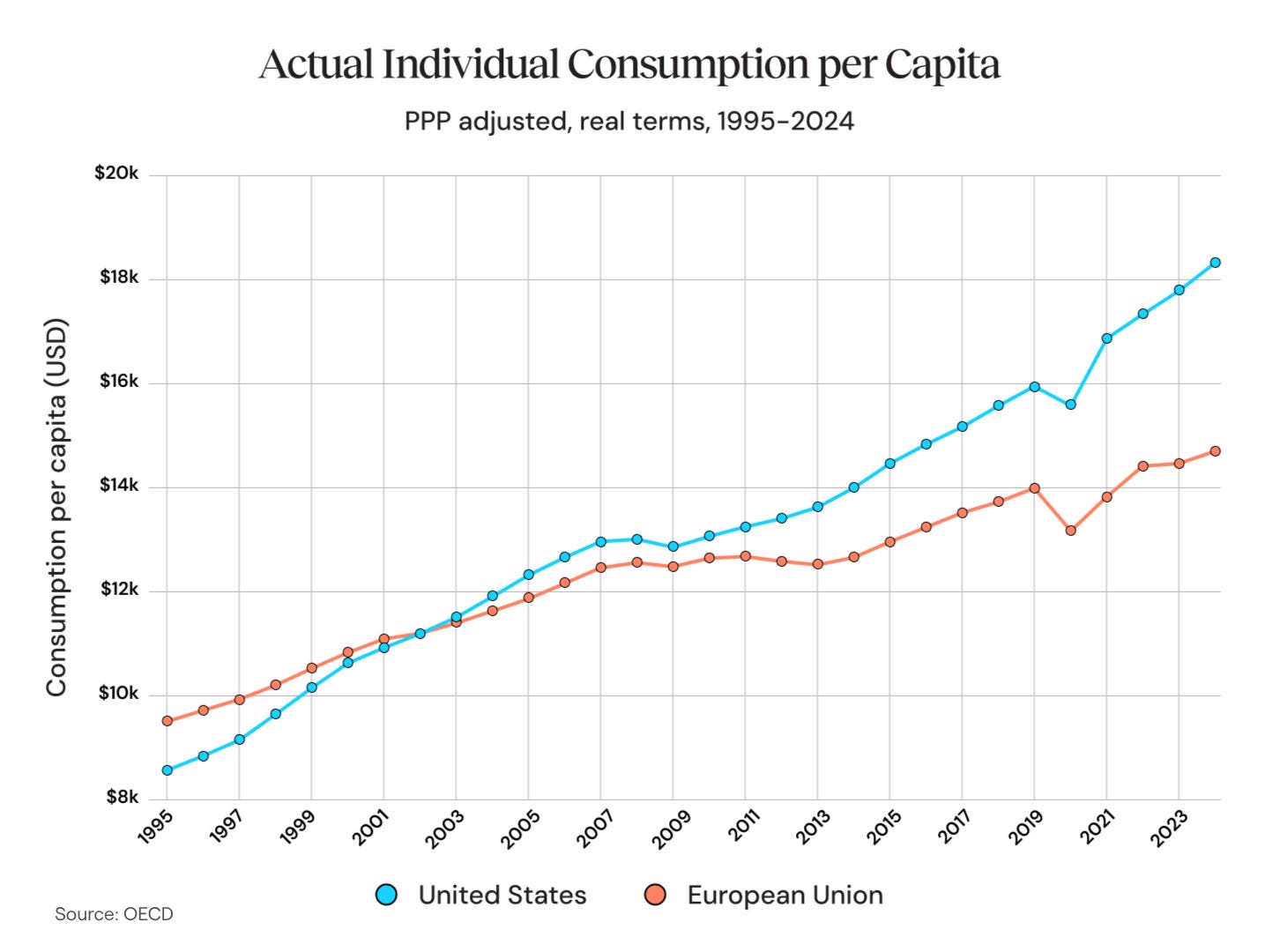
The same pattern holds across other economic variables. In the year 2000, the average worker in the (current) European Union produced $54 of economic value for every hour that they worked, measured in today’s prices. The average American worker produced $59 – a slight advantage. But today, Europeans produce $67 of per-hour value while Americans produce $84.
The gap is even clearer in markets. The US dominates global equities: American companies account for roughly 63 percent of the global MSCI ACWI index. US companies also command higher valuations. The price-earnings ratio of the MSCI USA is 35 percent higher than the MSCI Europe. Investors in the US markets expect stronger earnings growth in the future.
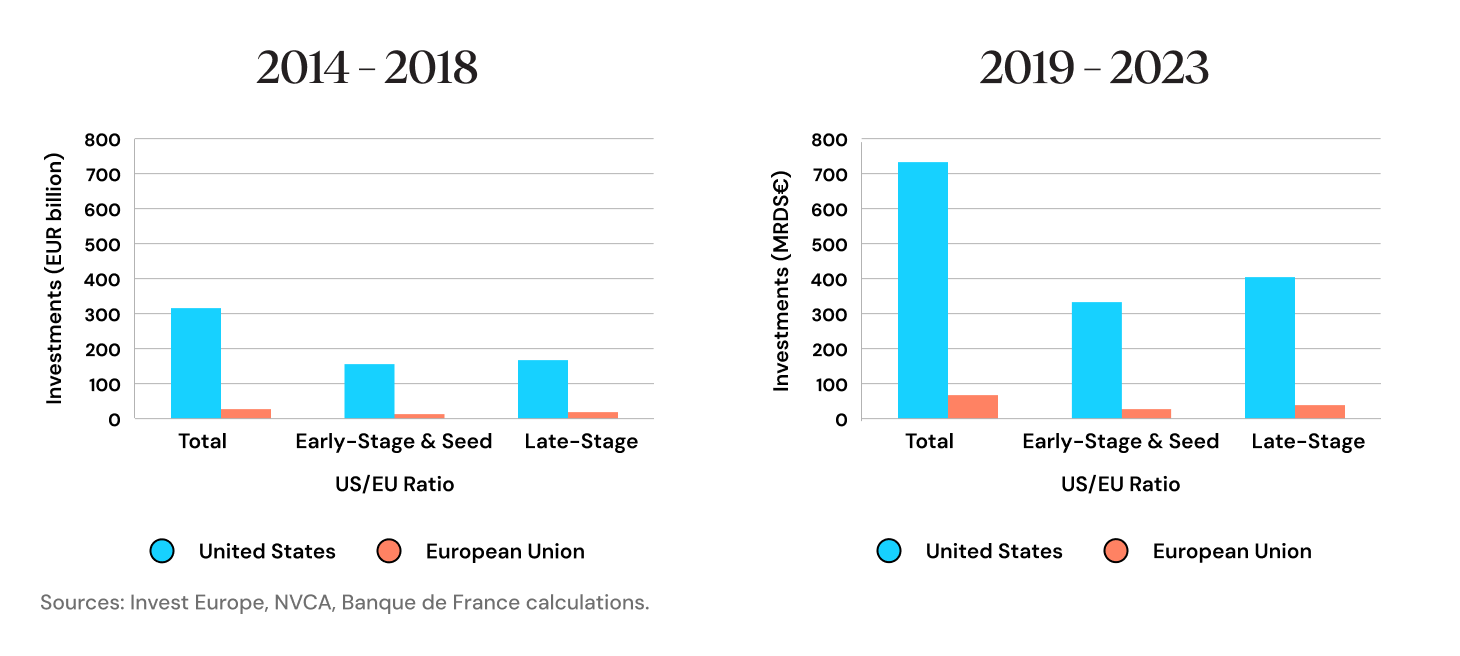
Closer to venture capital, the gap in fast-growing companies is larger still. In the past 50 years no company with a market capitalization above €100 billion has been founded in the EU. European venture capital has grown significantly over the past decade, but it remains structurally smaller than the US market. According to a recent paper by the Bank of France, America’s venture capital market is about 10 times the EU’s.
2: Diagnosing Root Causes
A growing number of Europeans are taking these problems seriously. In recent years researchers have published a range of reports diagnosing the problem. This includes Mario Draghi’s report in 2024, as well as Enrico Letta’s single-market report, the European Commission’s Competitiveness Compass and the new Savings and Investments Union. The conclusions are all broadly similar. Europe has too much fragmentation, too little risk capital and too much regulatory complexity.
The most obvious issue is capital. Europe is not poor. It has large household savings pools. In 2024 EU households saved well over €1 trillion (see chart below). This pool of savings could be put to use in turning fast-growing European companies into world-beating ones. Indeed, household savings are the ultimate source of risk capital.
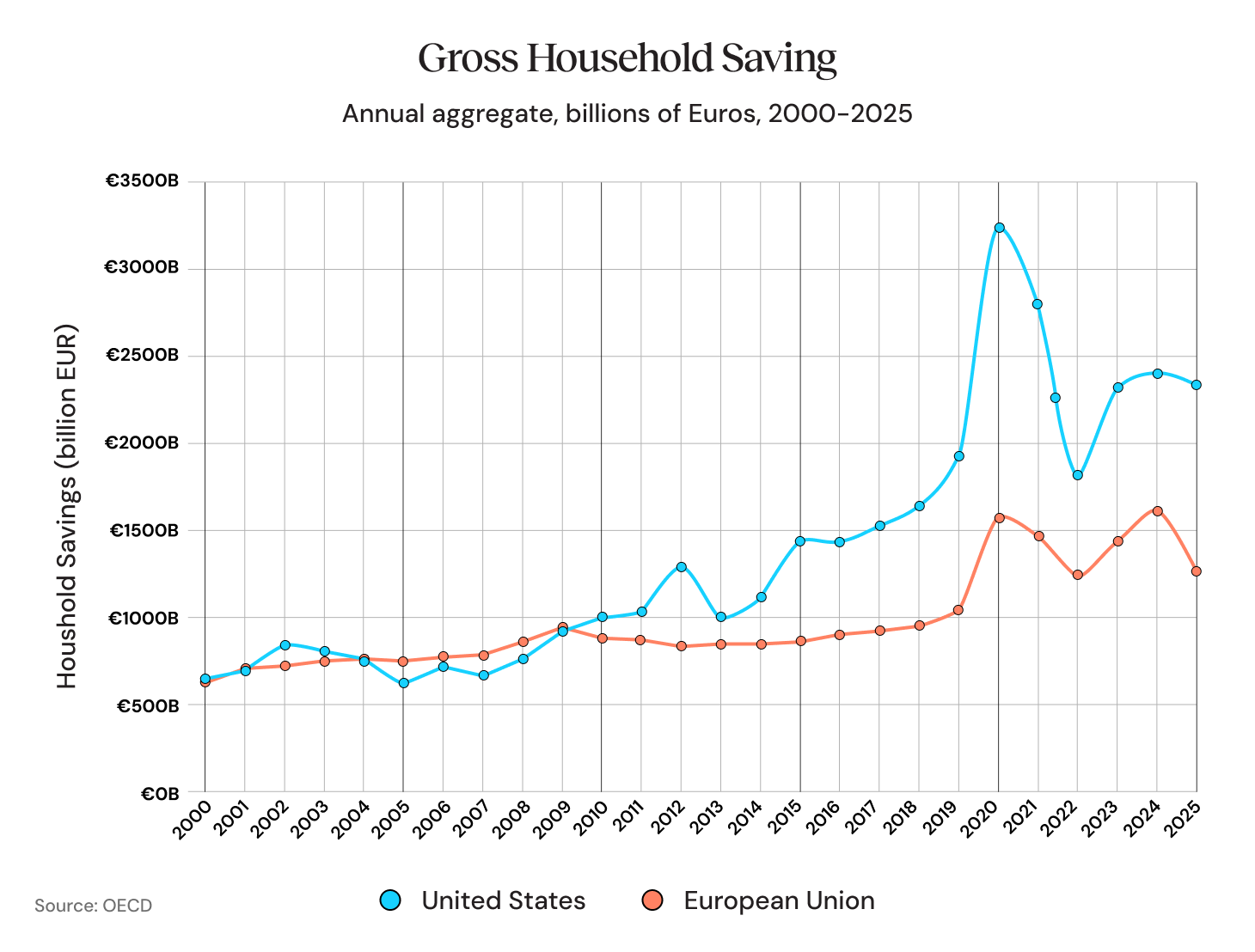
However, too many of those European savings sit in bank deposits, rather than being channeled into productive investment. This is partly a regulatory question: in parts of Europe pension funds are encouraged to put their assets into safe but low-returning assets, such as government bonds. It is also partly a cultural question. Americans are far more likely to be retail investors than Europeans, who seem to be more risk-averse on average. Without changes, European companies may continue to face a shortage of scale-up capital.
Europe is a continent but it is not a market. In fact, it is made up of many different markets operating in parallel. The promise of the single market was to abolish trade barriers between countries, allowing businesses in one country to provide goods and services in another. This promise remains fundamentally unfulfilled. Yes, there is free trade in goods – for example, wine produced in France can easily be sold in Italy. Yet Europe is a long way from free trade in services, from banking to the law. A French lawyer, for instance, cannot easily practice in Italy, even if fluent in the language. Europe was making real progress towards this goal during the 1990s and 2000s, but has made essentially zero gains in the past decade.
Policymakers across the political spectrum broadly agree on the diagnosis. The harder and more consequential question is whether that consensus can translate into coordinated action.
3: The Case for Reform
The skeptical case for European reform is easy to make. France is the obvious example. Emmanuel Macron’s pension reform raised the retirement age from 62 to 64, but it triggered intense opposition and was later suspended.
But the opposite cases matter more than they get credit for. Reform is politically possible in Europe, and when it happens, it changes economic outcomes.
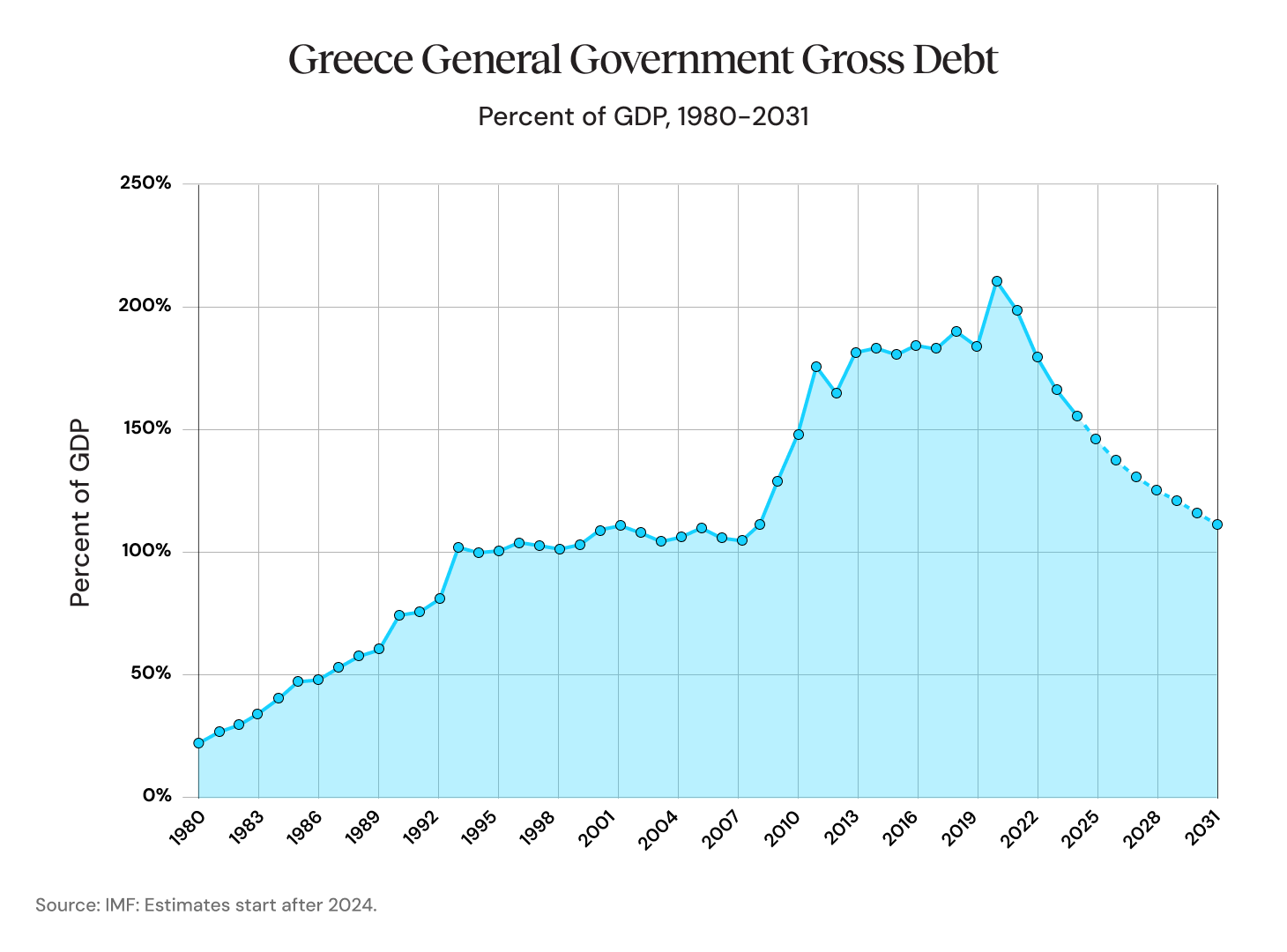
Greece is the strongest example. Fifteen years ago, Greece was the symbol of European fragility. Today it is one of the more convincing reform stories in the euro area. In recent years the country has made enormous strides in digitizing public services, helping to deliver them more transparently and at lower cost. It has also enacted large-scale labor reforms, making it easier to hire and fire. Product-market reforms have increased competition in a range of different industries.
The results are clear. Twice in the past four years, The Economist has named Greece “economy of the year”. Greece has delivered cumulative growth of about 20 percent since 2021, while public debt has fallen by more than 55 percentage points of GDP from its peak (see chart below).
The Baltics are another case study. Estonia, Latvia and Lithuania went through brutal adjustments after the financial crisis. These countries did this partly in order to meet the various macroeconomic targets that were necessary for them to join the euro, which all of them have now done. It was painful, but it preserved competitiveness and created a platform for later growth. Estonia in particular has since built one of Europe’s most successful startup ecosystems relative to population, with very high unicorn and VC density per person.
We focus on Greece and the Baltics because it helps overturn a common narrative about the EU: that it is in some sense “unreformable”. This is not true. They are also not the only examples. These cases remain underappreciated in mainstream economic commentary.
4: Early Signs
Europe’s turn may already be underway. From our interactions with European investors, founders and policymakers, we sincerely believe that people know that something needs to be done. The sense of urgency is palpable. We cannot quantify this, of course, though it is obviously important.
Alongside Greece, countries like Cyprus and Portugal are demonstrating that reforms are possible. Indeed for the first time, those three countries have a lower unemployment rate than the Nordics. This is a truly remarkable achievement that would have seemed impossible just a few years ago. In fact, the European economy’s overall labor market has clearly improved relative to the US. A decade ago the EU’s unemployment rate was 4.4 percentage points higher than the US’s. Today it is just 1.7 points higher.
Europe’s investment ecosystem is attractive, in our view. In the past year European public companies have offered investors a total return of well over 20 percent. Recent coverage has described “reasons to be cheerful about European tech”. For the first time, there is net movement of technology workers away from the US and towards the EU. Venture capital spending is rising fast. Paris and London, in particular, are global centers of AI.
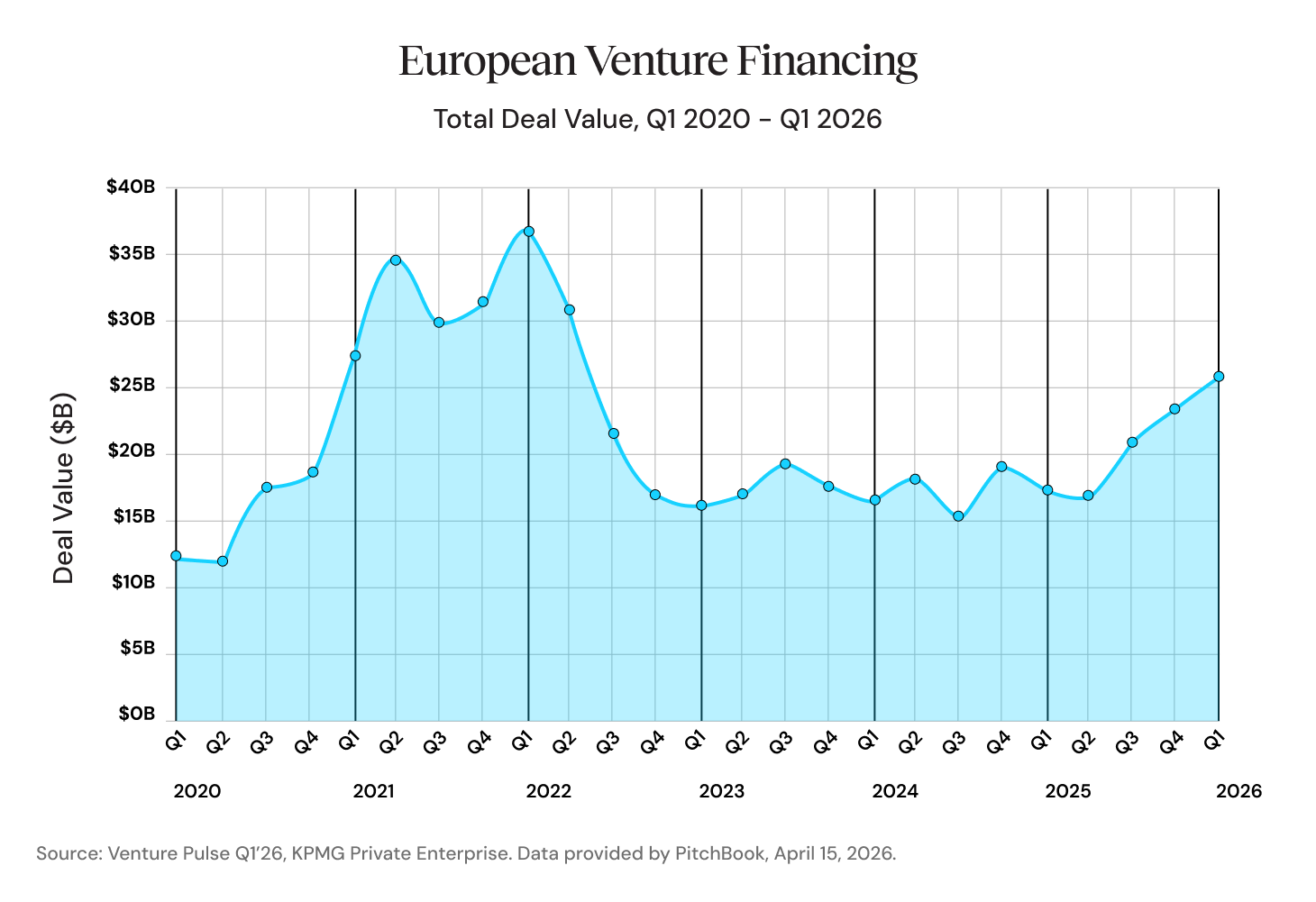
Our view, though, is that expectations for European companies are still constrained by the belief that the European market has a low ceiling. If reforms proceed as we expect, that ceiling will rise higher and higher.
Final Thoughts
The stakes are high. Europe’s challenge is about maintaining the European project. The continent needs to finance defense, aging, welfare states and strategic autonomy without drifting into fiscal stress.
The pessimistic view is that Europe is too fragmented, too slow and too politically constrained. The optimistic view, to which we subscribe, is increasingly credible.
For investors, this creates a clear framework. Europe is still under-scaled, under-capitalized and under-valued relative to the US, but also has large savings pools, world-class talent, strong research, and policies which are improving. If even part of the reform agenda is executed, Europe could be in for a great decade.