



Everyone says they “use AI.” Far fewer use it in ways that truly stick.
In an ecosystem driven by hype, separating real adoption from “AI tourism” is difficult. To cut through the noise, we partnered with the Early Builders community and surveyed 100 fast-growing European startups, from Pre-seed to Series B+, to understand which AI tools are actually embedded in day-to-day operations.
Here is what the data shows.
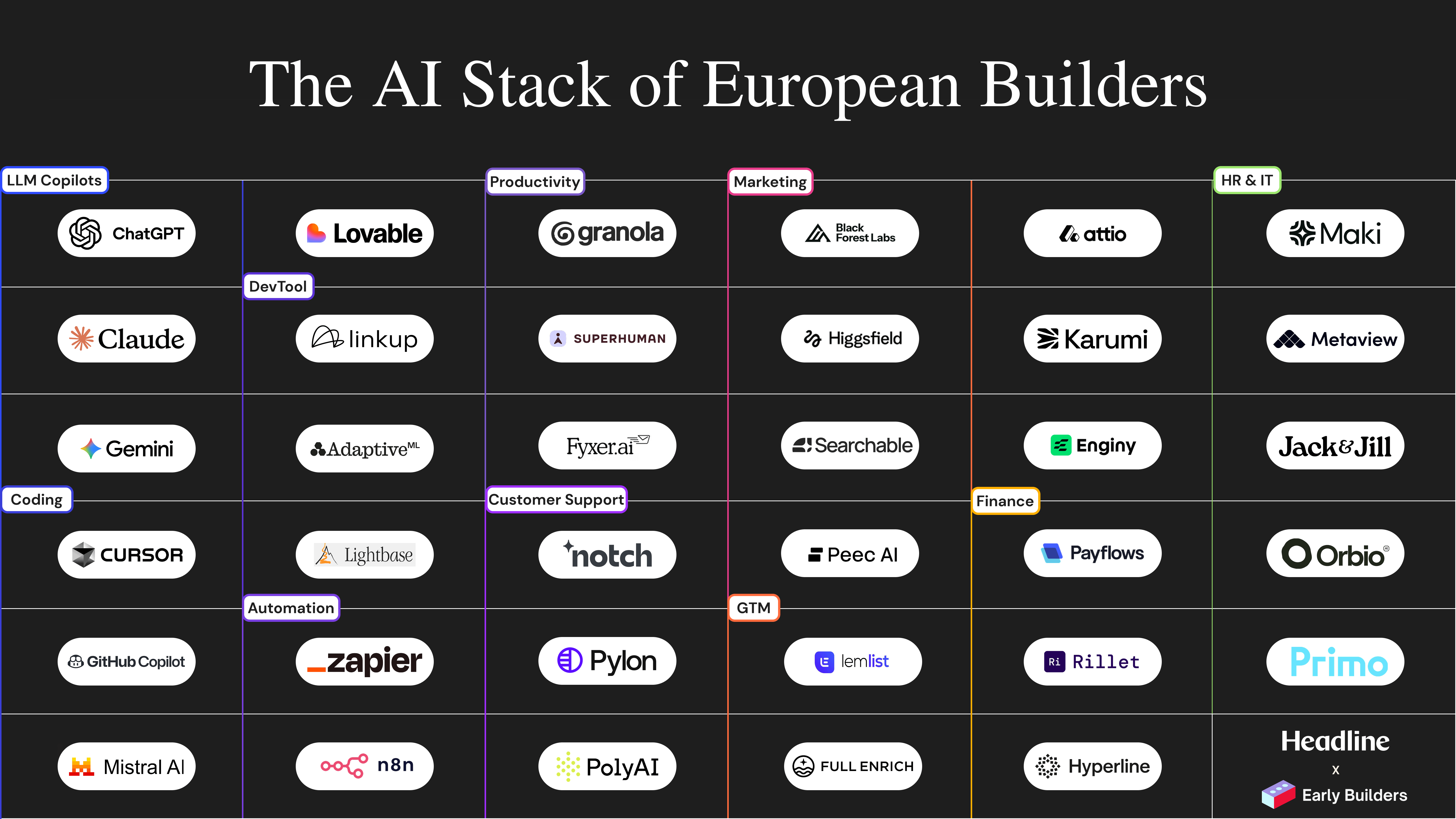
The Giants Are Compounding (and Co-Existing)
The “winner-takes-all” narrative doesn’t really hold at the application layer. In the AI era, the winners take most, but they often take it together.
ChatGPT remains the default cognitive layer, with 89% penetration. Claude has rapidly caught up, reaching 66%. Importantly, startups are not choosing one. They are paying for both.
Teams typically lean on Claude Sonnet for advanced reasoning and coding, while keeping ChatGPT for general-purpose tasks. This “multi-model by default” behavior drives unusually low churn for the leading AI platforms and allows revenues to compound rather than rotate. OpenAI and Anthropic doubled their ARR in H2 2025, reaching $20B and $9B, respectively, after tripling and quadrupling, respectively, in H1 2025.
The same pattern appears in developer tooling. Cursor leads with 76% adoption, yet GitHub Copilot still appears in 44% of stacks. Builders actively A/B test tools in production and accept duplicated seat costs to ensure best-in-class performance and reliability across edge cases.
Automation follows a similar logic. While multiple tools co-exist, European startups show a clear preference for technical depth: n8n has overtaken Zapier in our panel (56% vs. 31%).
“We try to select the best AI tool for each team’s use case. Using ChatGPT and company-wide custom GPTs for general-purpose tasks. Claude Code and agentic frameworks for engineering and Gemini Image generation for our content production.”
From Chat Interfaces to Agentic Workflows
While incumbents are compounding, the defining shift in 2026 is how AI is being deployed. The ecosystem is moving beyond chat interfaces toward agentic, multi-modal workflows. Tools that actually run processes, and not just answer prompts.
Coding & Data: Building Agent-Ready Infrastructure
Cursor and Lovable (76% and 35% adoption) have largely consolidated the interface layer. But consolidated doesn’t mean static. Recent Claude releases are gaining visible traction among developers, and Mistral has just announced a next-generation coding assistant, reopening competition at the model and system level.
As interfaces stabilize and models keep evolving, the real inflection point is shifting deeper in the stack. Startups are moving away from generic API calls toward infrastructure that makes LLMs reliable in production. Several functional layers are emerging:
Structure: Companies are adopting .txt to push LLMs out of conversational ambiguity and into strict, machine-readable formats (JSON, Regex).
Grounding: Hallucinations remain a key blocker. Linkup is emerging as a bridge between static models and the live internet, offering a search API that grounds agent outputs in verifiable data.
Context: One-size-fits-all models are losing relevance. Dev teams are turning to Adaptive ML to fine-tune open-source models around enterprise KPIs, and to Lightbase to give agents contextual awareness of the entire codebase architecture.
Productivity: The Unbundling of the Workspace
For now, users are rejecting all-in-one assistants in favor of tools that do one job exceptionally well.
Granola reached 37% penetration by focusing on being a high-quality notepad for humans. This “niche-first” strategy is spreading across the productivity stack. Fyxer and Superhuman are taking over the inbox through automated triage and draft replies, while calendars are increasingly managed by dedicated tools such as Reclaim, and meetings are prepared by Himala.
History suggests this fragmentation won’t last. As tools like Superhuman expand from a wedge (email) into a broader team workspace, the category’s eventual winners are likely to consolidate use cases once they’ve earned consistent daily usage on their first wedges.
Customer Support: The Reliability Engine
Customer support is one of the few functions where LLMs already deliver clear value with very strong ROI. Adoption is accelerating even among small teams.
PolyAI (voice) and Pylon (mostly B2B startups) have become standard choices for handling complex interactions. The next phase is full autonomy, and Notch is at the forefront, resolving up to 70% of customer inquiries end-to-end (including complex edge cases) through omni-channel agents, without human intervention.
Marketing: Video Infrastructure and the Rise of GEO
Marketing is shifting on two fronts:
Video Infrastructure: As frontier models like FLUX from Black Forest Labs hit new performance levels, more value is being created at the application layer. Tools built on this infrastructure, such as the ad generator Higgsfield, are on a path to commoditizing high-end production costs.
Generative Engine Optimization (GEO): As users turn to AI answer engines instead of search, SEO is being redefined. Tools like Peec AI and Searchable help brands measure and optimize their “share of chat”, enabling marketers to understand how LLMs perceive and surface their brand. Ads inside ChatGPT will become a major acquisition channel, making GEA a core capability for GEO players and likely sparking a new wave of dedicated entrants.
Sales: From Systems of Record to Systems of Action
In sales, pre-AI tools like Lemlist and FullEnrich remain foundational for sequencing and data enrichment. The real shift, however, is happening in execution, where teams are experimenting with different approaches to automate the sales job itself.
Attio is an excellent example, implementing AI action features into its system of record and turning it into a system of action. In parallel, there are use-case-focused plays like Karumi, which replaces static “Book a Demo” flows with interactive video agents available 24/7, or Enginy, which deploys autonomous outbound agents that manage the full prospecting loop.
Finance: From Spreadsheets to AI Teammates
In finance, static spreadsheets are becoming obsolete. A new category is emerging around the “finance operating system”, with different wedges for different customer segments.
Payflows is rebuilding the financial stack for larger scale-ups around autonomous agents that manage discrete workflows. Rillet has similar ambitions for mid-market companies, while Hyperline addresses revenue management and billing complexity, freeing finance leaders to spend less time reconciling and more time making strategic decisions.
The Road Ahead
Adoption velocity is unprecedented — and reversible. The recent spike in Gemini 3 usage illustrates how quickly buyers are willing to switch when performance improves.
For founders, the challenge is no longer adding AI features. It is building organizational agility. The next generation of winners won’t be defined solely by model quality, but by their ability to integrate AI deeply into daily workflows, while staying flexible as more capable agents emerge.
The respondent panel comprised 100 European startups across eight countries. Each company reported the tools it uses across the following categories: LLM co-pilots; knowledge management and workflow automation; personal productivity; coding and application development; marketing; sales and GTM; customer support; finance; and HR.
For each tool cited, respondents also estimated internal penetration, defined as the share of employees using the tool relative to total headcount. The penetration rates shown above reflect the proportion of companies that reported using each tool.
